


For junior Aadya Subramanian, Korean popular music, abbreviated as K-pop, is something that she’s been interested in for a long time.
“My friend’s interest sparked my curiosity in K-pop and I also wanted to relate with them, so I started listening to the most popular group I was aware of, which was BTS. I was pleasantly surprised by the music and I fell into the K-pop hole very quickly. I have been interested in K-pop since 2022, so I’ve been in the community for 4 years now,” Subramanian said.
Interest in K-pop has skyrocketed in the United States. According to Morgan Stanley, K-pop generates over $513 million annually in the nation, and in 2024, K-pop artists occupied 7 out of the top 10 spots for the best-selling CD albums.
Senior Zaina Khan, who also enjoys K-pop, also said she was introduced to the genre when she was younger.
“I think when I was in elementary school I heard of K-pop songs but I didn’t know they were actually K-pop. And then I think in like 6th or 7th grade, someone recommended a show to me and it was a K-drama,” Khan said. “So I started watching it, and I was like, oh, this is really interesting. I liked the songs that they played as well, and so I looked into some of the songs, I was like, oh, these are really good, oh, this is K-pop.”
Benefits and Friendships
For students who enjoy the genre, being a part of the K-pop fan community is a beneficial experience. Subramanian said there are many benefits to K-pop.
“K-pop has positively impacted my life because it’s given me music that I can find comfort in and get pumped up by when I need an energy boost,” Subramanian said. “It also made me laugh more because K-pop memes are just built differently in terms of humor.”
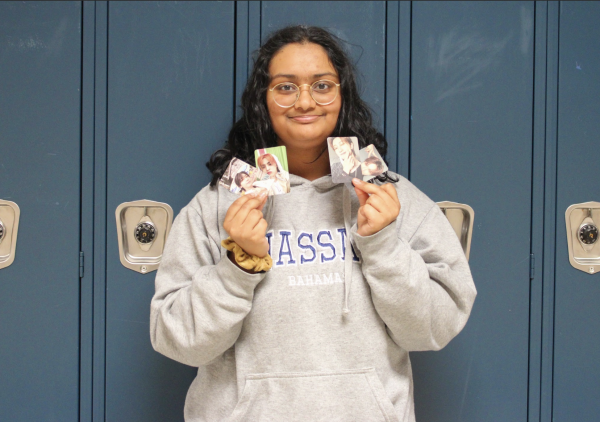
(Marianne Guo)
Subramanian said the creativity of K-pop fans has a positive influence on her hobbies.
“The creativity of fan culture has inspired me by making me also want to get creative as well with my own works. Drawing is one of my favorite things to do, and I love drawing my favorite idols,” Subramanian said.
Junior Irene Hwang said K-pop has led her to new friendships.
“I’ve made friends who like the same groups as me, and we like talking about albums, comebacks, and performances,” Hwang said.
For Khan, K-pop has strengthened her own friendships as well.
“I think it’s always been a nice conversation topic with my friends. So the best example that I can think of is I have a friend who lives in Pennsylvania right now, and we used to be super close in middle school, and we were close in elementary school as well, but we really bonded with K-pop and stuff like our favorite groups,” Khan said. “So when she moved away before high school, I think we were able to connect over sending edits to each other or just sharing music. And so we’re still extremely close.”
Subramanian also said K-pop has led to friendships, both in real life and online.
“I have formed some close friendships through K-pop, one of them being with my friend who had sparked my interest in K-pop. I have quite a few close friends in real life that I can somewhat talk to about K-pop, and I’ve also found online friends that I can geek out about K-pop with.”
What makes K-pop unique
Idol groups are a major part of K-pop. According to Buzzfeed, idol groups are highly trained entertainers under Korean entertainment agencies, produced to deliver polished performances in singing, dancing, and visuals. For Hwang, these idol groups are what attract her to the genre.
“My favorite thing about K-pop is how creative it is, everything from the music and performances to the visuals and style. I also love how every group has its own unique style and story,” Hwang said.
Subramanian also said she enjoys watching idol groups and their non-music appearances.
“My favorite thing about K-pop is the energy, which is present in both a group’s performance and the way fans cheer them on,” Subramanian said. “I also love watching variety shows that idols star in, like SEVENTEEN’s show “GOING SEVENTEEN” because it’s just very entertaining and hilarious and showcases a more fun side of groups in comparison to the seriousness of their stage performances.”
Khan also said the diversity in K-pop music contributes to the uniqueness of the genre, as well as her enjoyment.
“I just like how diverse it is, and obviously I like how the music sounds, but there’s just such a huge diversity in what K-pop is. I think a lot of people, like, tend to kind of stereotype K-pop a little bit, too,” Khan said. “But, at the end of the day, there’s so many different groups and so many different genres within K-pop itself, which is what appeals to me.”
Dance and K-pop
Dance Magazine finds that dance has been a central feature of K-pop music since the industry’s founding, and today, nearly every K-pop song has corresponding choreography. Idol groups with multiple members perform dances that combine hip-hop, urban, and contemporary styles.

Khan said recreating dances from K-pop idol groups is a big part of the fan community.
“I think when people do the dance covers or the makeup covers of all the K-pop songs, it’s very, very inspiring. I think it’s just cool to see that the people in this fandom are so talented and creative,” Khan said. “I’m not gonna say I’m the best dancer or anything, but me and my friends like to do dances when at birthday parties.”
Director of Dance Leah Stupeck said performing K-pop dances that involve group participation are both engaging and exciting.
“It’s definitely more fun to come and take class with your friends and to be able to create something with another person is really exciting,” Stupeck said. “But then when it’s even a bigger group of people, then that’s where it becomes really rewarding for not only me as a teacher, but as a student too.”
Hwang said K-pop amplified her passion for dancing.
“Watching idols perform gives me ideas and inspiration for my own moves,” Hwang said. “K-pop gives me a lot of inspiration with motivating music and fun new dances to learn.”
Stupeck also said interest in K-pop can heavily influence dances in the performance space.
“Since K-pop music is popular right now, we do see that influence more on the competition stage or just in performance because we’re including those intricate movements that are very together, with large numbers of people, which is different than maybe we’ve seen before in the past,” Stupeck said. “Dance is just influenced by everything around us.”
The Other Side
However, every fandom isn’t perfect. Subramanian said the way idol groups are presented to the K-pop fan community can lead to toxicity.
“I think that some of the more negative aspects of the community are the toxic behaviors exhibited by fans towards idols and each other. I believe that the primary cause of these issues are the boyfriend or girlfriend persona that companies force on their idols for marketing purposes, coupled with the insecurity of these toxic fans.”
Khan said some fans will show excessive behaviors towards their idols or favorite K-pop groups.
“I think a lot of times fans are very possessive over their K-pop idols. It’s especially true for dating rumors and things,” Khan said. “People are like ‘oh, I’m so disappointed in this idol because they started dating.’ And so, I think that’s led to a lot of toxic culture in general with idols not being able to really share their personal lives.”
Students find that behavior has happened in the K-pop fan community to a noticeable extent. Subramanian said she sees such toxicity through fans who develop parasocial relationships with K-pop idols.
“This causes fans to develop a one-sided, parasocial relationship with their idols and push away others that they view as a threat to their ‘relationship,’ whether that be other fans or other idols,” Subramanian said. “I’ve noticed this happen often when fans form parasocial relationships with male idols and viciously attack female idols and female fans that they perceive to be ‘stealing their man.’”
Hwang said K-pop’s popularity is a main reason for its drawbacks.
“K-pop definitely has its benefits and plays a big role in Korean culture, but with it being such a big part of Korean culture it brings a lot of drama,” Hwang said. “A lot of it comes from people being overly competitive or taking opinions too seriously in the community.”
For Subramanian, the difference in fan responses to female and male idols is also a negative aspect of the community.
“Another negative aspect that I have noticed seems to be deeply rooted in societal misogyny, as there is a very different response by fans towards a male idol versus a female idol when either does something controversial,” Subramanian said. “Male idols are often fiercely defended by their fans, while female idols are harassed, shamed, and cursed at relentlessly.”
Avoiding Toxicity
In light of the toxicity some K-pop fans exhibit, Khan said in her personal experience, finding new interests helps to steer away from negative behavior.
“It’s a realization that this is just one aspect of your life. And I will say for myself, I was really into K-pop in my middle school and ninth grade years, and now, I still listen to it, and I am still a fan of different groups,” Khan said. “But I also listen to other genres of music and there are other hobbies and things that I have taken up.”
Subramanian said she shows support to her favorite idols instead of participating in toxic conversations.
“My favorite way of showing support to K-pop artists I enjoy is by listening to their music, reposting their content on Instagram, and drawing them,” Subramanian said.
Ultimately, Khan said it’s important to not let K-pop be the only interest in anyone’s life.
“I think it’s important to realize that these are almost like phases of our life, and they’re important phases of our life, and it’s good to take the good out of it,” Khan said. It’s also important to realize that you shouldn’t center your entire life around this one hobby, or this one music genre, or these few people that have, yes, brought you happiness, but also shouldn’t determine everything about you.”