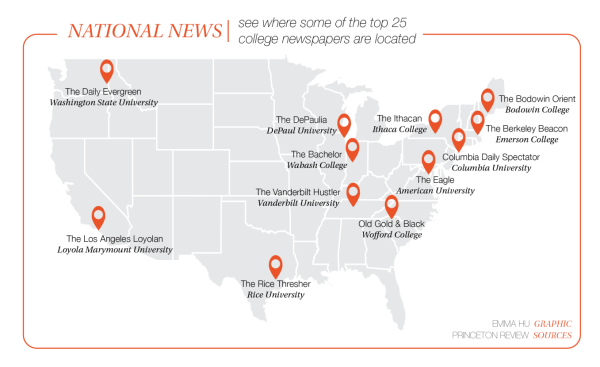


On Oct. 14, Indiana University Media School officials fired Jim Rodenbush, the student media director for the Indiana Daily Student (IDS), after instructing the IDS that its upcoming print issue could only include Homecoming content, with “no other news at all.” Rodenbush, along with student editors at the IDS, protested the order, calling it an act of unlawful censorship.
However, media censorship at IU is not a new occurrence. In 2024, administrators eliminated the weekly news editions of the IDS, allowing only special issues covering IU events and activities—like the Homecoming edition. Recently, the Foundation for Individual Rights and Expression (FIRE) ranked the university as the third-worst school for free speech rights followed in order by Columbia University and Barnard College.
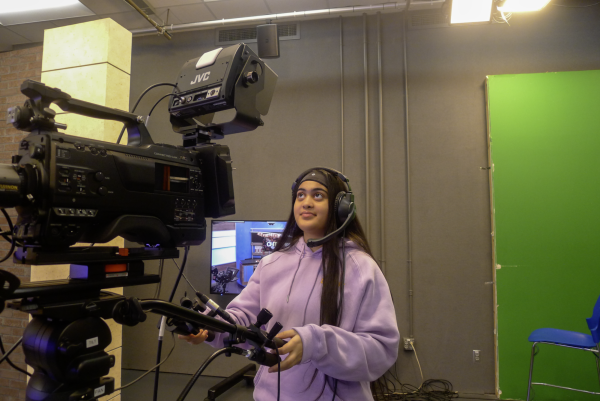
When Malia Larger, CHTV news anchor and junior, found out about the IDS controversy, she said she was shocked.
Larger said, “I mean, what’s happening around the country in universities is surprising. You’d expect most students to be heard all around the school, but this shows that they are more limited. So it kind of just shocked me that (censorship) would happen.”
Attack on free speech
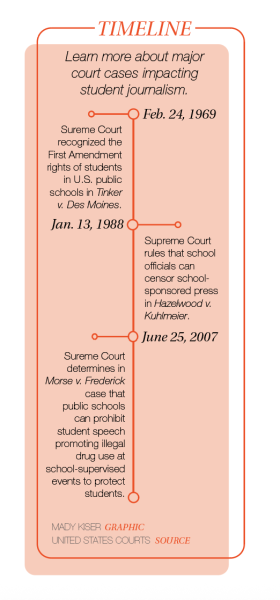
According to WHJE adviser Dominic James, the censorship of the IDS was a blatant attack on free speech rights that forecasts the future of media in the United States.
“It concerns me that First Amendment rights are being taken away from university students. It is the foundation of being a journalist. (They) are there to report on the truth, to report on the facts whether or not the institution you’re working with likes it,” James said. “That’s what journalists are for. They’re to ask the difficult questions. That’s such an important thing in a democracy. If everybody goes along with the people in charge, then we have a dictatorship.”
Gurleen Kaur, CHTV reporter and junior, said she believes censorship is a harmful practice with no place in a democracy.
Kaur said, “It’s important that all voices are heard, not just the ones that are (in favor) of the college. (It’s important) that the media and journalists prioritize facts and coverage that is unbiased.”
Additionally, she said student media organizations are more often censored when they cover controversial issues.
“I definitely think that the type of media being published has a lot to do with censorship. A lot of it is especially for student-run organizations in high school and I guess in university,” she said.
Applications to high school journalism
While professional and collegiate media is subject to different regulations than high school publications, James said the principle and threat to free press everywhere still stands.
“It seems to me that my understanding of the rules and the law regarding the First Amendment is that the college, the university or the student newspaper, has the ability to print what they want, which is slightly different from high school publications. It is quite concerning that (free speech rights) are being taken from university students and professional journalists who are trying to do their jobs.”
Kaur said she feels a bit of pressure in determining what topics are appropriate to be covered by high school media networks.
“I came into this thinking that I would be able to talk about anything—political and otherwise—but I feel like, at least a little bit, that I have to be school appropriate because it is still high school.”
On the contrary, Larger said she feels like the media at this school maintains a good balance between propriety on the high school level and journalistic integrity.
“I think definitely at the high school, we do a really good job, making sure students’ voices are heard while also having an adviser or someone guiding what you write or talk about. They don’t really say you can’t cover something but they sort of help to direct you when something may be controversial. But I feel like (the IDS) situation was very different. It probably should have less oversight since it’s a college newspaper,” she said. “I think the issue also stems from national politics and it works its way down to university and high school journalism.”
IDS Administrative Issues
Although observers and students quickly labelled the controversy as censorship, media center specialist Teresa Ramos said the reality might be more complicated than that.
Ramos said the IDS had been operating at a deficit for years, making weekly print editions unsustainable.
“It was really about not having enough money to continue to publish and print,” Ramos said. She added that IU had notified the IDS that it would eventually need to transition to a fully online platform, something many student newspapers across the country have already been forced to do.
However, the abrupt firing of Rodenbush and the timing of the Homecoming-only directive made the situation appear, at least externally, like administrative interference. Larger said the financial explanation seemed to be convenient as a cover-up.
“I think that while money and finance could be a valid reason to cut down on (IDS publication) it also seemed awfully convenient especially with the firing of the director,” Larger said. I can’t say for sure but I feel like it could have been used as a shield.”
James also said IU’s reasoning—referring to the online-only initiative—was unconvincing.
“The argument they used to shut down the printed publication is something they could use again for an online publication,” James said. “It gives them the impression they have control over the organization, which they shouldn’t have.”
Future of Free press
The IU incident comes at a time when free speech on college campuses is under heightened national scrutiny. Across the country, universities are facing pressure over how they respond to student protests regarding Palestine, with several institutions restricting access for student journalists or warning them against publishing certain coverage. According to data from FIRE, these actions reflect a broader pattern in which colleges are increasingly willing to intervene in student reporting, raising questions about how committed universities truly are to protecting open discourse.
James said the national environment makes what happened at IU especially concerning. He said the situation resembles a larger trend of universities asserting control over student journalists and limiting their ability to report freely. James said he worries this moment signals “First Amendment rights being taken away from journalists on a national and collegiate level,” adding that reporters cannot do their jobs when administrators determine which stories are permissible.
Larger said the controversy changed the way she views her own work as a student journalist. She said it made her recognize that “there’s people… changing (stories) to how they view it,” something she said she believes restricts student writers from fully expressing their perspectives. Larger said student media should stay independent, with advisers offering constructive guidance rather than directing coverage. She added that IU administrators should “listen to and trust” student journalists because they understand what their campus community wants to read.
Ramos said student reporters should be free to write about issues that matter to their communities, but she emphasized that freedom must be paired with responsible reporting. Journalists, she said, should operate “ethically, and make sure that they are adhering to what’s right, and not just writing what looks good or what will get a reaction.”
As debates over free speech continue across college campuses, the future of student media will depend on whether universities choose to protect or limit student expression.
Larger said, “Free speech is important especially for journalists. (Journalists) are there to report the facts and the truth, so if censorship is going on there are bigger problems.”