


For junior Judah Joseph, his decision to pursue nursing was one influenced by his personal circumstances and values.
“I’ve always wanted to help people in some sort of way,” Joseph said. “I’ve never really understood until I was diagnosed with my autoimmune disease and I realized I want to help kids who have the same type of condition as me. That’s how I decided to get into nursing.”
Junior Veda Vivek said her decision to pursue nursing came from her neighbor.
She said, “My neighbor is a nurse practitioner, and I shadowed her. (And) I realized that I really like to deal with that, and then I realized that there was a nursing program in our school. I really can’t see myself doing anything other than nursing because I have no interest in anything that’s not medical related, and I don’t want to go into anything else.”
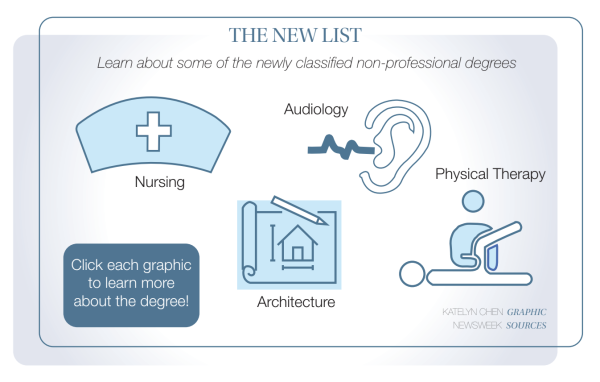
Joseph and Vivek’s pursuits toward a career in nursing is a sentiment expressed by many high schoolers; a poll conducted by Science Direct found that 47.6% of high school students expressed a desire to pursue nursing. In late 2025, The U.S. Department of Education reclassified nursing—as well as other degrees such as audiology, architecture, education, social work and physical therapy—as a nonprofessional degree; as such, federal loan caps for graduate students pursuing these fields will be significantly lowered, effective July 2026. Joseph said when he first heard about the redefinition, he was upset and saw it as a roadblock for students who needed financial assistance.
He said, “It really sucks that nurses can’t get that big of a student loan anymore, because medical school and nursing school is very expensive, and sometimes people who are in financial crisis need that, so it really is upsetting.”
Nursing at this school

According to Shane Kohl, Emergency Medical Services (EMS) instructor, the EMS and CNA classes offer unique opportunities for students who have a passion for helping others,
“I think a lot of them want to pursue a career in the medical field. Some want to be nurses, anesthesiologists, doctors, surgeons, so starting out in a high school EMS class setting really gets their eyes open to the broad spectrum that could be in healthcare,” Kohl said. “Another program here is CNA (Certified Nursing Assistant), and that’s kind of more confined to this particular age group, working in nursing homes and living facilities, but with the emergency side of things, we see a wide variety.”
Vivek said the CNA class is distinctly hands-on.
“We learn a lot of skills that we use in clinical settings, like how to deliver ice water and feed residents and change them, (and) how to assist with toileting and bathing.”
Toni Watson, Pre-Nursing Pathway instructor, said learning skills is a big piece of the CNA class.
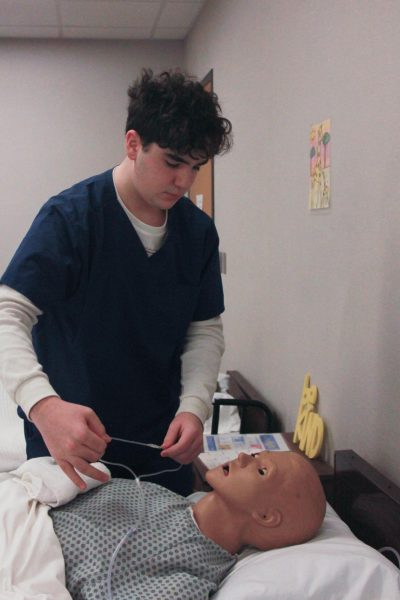
“They have a book that is (about) resident care procedures, and before they can even apply for the certification, they have to demonstrate and learn and get checked off on all 72 skills. So it’s a lot for them to learn, so seeing them be very nervous initially and then having that confidence at the end, getting through some of those skills, and then also the opportunities to learn like medical terminology is like a different language in itself,” Watson said. “Also with principles of healthcare, we look at them developing employability skills, working on study skills, learning about different health careers, focusing on patient communication and things like that to kind of help them be a well- rounded future healthcare professional.”
Additionally, Watson agreed students who typically take the Pre-Nursing Pathway do so because they are interested in pursuing nursing at a college level, but there have been other trends as well.
“I would say probably 95 to 98% of the students want to pursue nursing or some health career. Some of them want to do nursing in a hospital. Some of them are looking to become nurse practitioners, some of them even want to be a doctor. So I would say the majority of the students do want to pursue that nursing pathway,” Watson said. “One thing I have seen that’s changed since I’ve been teaching, I’ve been teaching in health sciences for five years. I’ve seen more males, and that’s kind of exciting, too.”
Significance
Vivek said the redefinition of these professions is very different from the treatment of nurses during the pandemic.
She said, “During the pandemic, nurses were one of the most important people that were helping. (And) then the government was like, ‘Thank you to all these professionals who saved everyone.’”
Kohl agreed students should be aware of the reclassification, but also suggested they explore other healthcare programs.
“I think it’s important to be aware of it, but I think there are other options in healthcare, especially with nursing. Again, we talked about the paramedic program that there’s a transition to our end. So that’s a viable option if it’s a financial aid issue,” Kohl said. “But I think having a plan in place when they leave Carmel High School or any school, for that matter, is important to know how they’re going to achieve their goal and how they’re going to pay for it.”
Joseph said something something about how the reclassification doesn’t accurately reflect the work involved with being a nurse
“Being a nurse is extremely difficult, especially if you’re gonna be in the ER or anywhere else. Some days, it’s not as demanding; it depends on how the residents feel and how the patients feel. And then, some days, it’s harder with having to clean up extra messes or having to care for more people at one at a time.There are so many different responsibilities with each field that it is entirely hard to classify that.”
Vivek added the redefinition would cause financial complications for those interested in a nursing degree.
“It changes student loans and things related to money. Some people might struggle if they don’t get proper student loans because they can’t afford to go through four years of college or a master’s if they want to pursue that,” Vivek said. “So a lot of people might not be able to become nurses, especially when we’re also experiencing a shortage. Now more people are not going to want to be a nurse because it’s not considered a professional degree.”
Financial implications and awareness

Joseph said the loan reductions would likely affect the number of nurses entering the workforce.
“I think it’ll definitely hurt the amount of nurses already that are needed,” Joseph said, “especially since that if kids can’t get financial assistance, they can’t attend nursing school and medical school, and can’t pursue what they need to do, and we’re already at a nursing shortage, so there’s that.”
In regards to the academic futures of students, Kohl agreed limits to financial aid at the graduate level will affect the choices made at the high school level.
“I mean, they have to have a way to pay for their secondary education. So if it means they have to do more of a hybrid program or a bridge, um, program to get to their long-term goal. That’s going to play a factor.”
Watson disagreed and said limits to financial aid at the graduate level are not as significant as a student’s personal interests for their academic future.
“I don’t know that they think that far ahead in terms of, am I going to be able to afford this? I think they have set in their mind, and I love this about them, that they want to be a nurse or they want to be a nurse practitioner, and this is their goal,” Watson said. “So I don’t get the perception that they are limited by that in any way. I think they are really just staying the course, focusing on this step in their journey, and then just getting prepared for post graduation.”
Vivek said students at the high school should be aware of this change.
“I could definitely see it pushing people away from it (non-professional degree subjects). We don’t know what situation certain people are under,” Vivek said. “So if someone isn’t aware of it and then they spend that much time doing it and then it has no purpose, I don’t think that’s fair. So I think they should know about it before pursuing that choice.”
Although Judah agreed the reclassification should be taken into consideration when choosing a pathway, he said it shouldn’t necessarily restrict them from pursuing it.
“I think they should definitely know about this, but also, I think these pathways are a good way to see what it would be like in the future,” Joseph said. “Kids should always still do this type of class to explore what they want to do in the future and see what nursing would be like.”
Watson said awareness about these changes to degrees is important at a high school level.
“I do think they should be aware because that might help them sort of clearly define their pathway,” Watson said. “Sometimes people go to college and they’re not sure like, what they want to do, so they can explore a little bit and have that cushion of maybe parents paying for college or, you know, a little extra scholarship or the availability for loans, but if those loans are going to be limited, that will kind of force students to really focus on what path do they want to take, and really look at their specializations.”
Watson added awareness becomes increasingly important when these changes involve required degrees.
“I think it’s important for them to know, especially for those who are interested in, like clinical nurse specialists or nurse practitioners, because those professions require a master’s degree. So that’s something that they should be aware of in planning ahead,” Watson said. “There are opportunities for them to maybe connect with an employer who would, you know, possibly provide tuition reimbursement. So those are some things that they should just think about for their future.”
(Kodai Fujita)
Effects on future careers
Kohl said the redefinition of professional degrees has led to a new trend in the programs he oversees.
“I’ve seen more of a desire to be like a paramedic to the RN program. With nursing now becoming more like a non-professional field, it’s become more difficult for financial aid,” said Kohl. “Students can complete their paramedic program in about a year and then do a transition to RN in about 18 months. So it cuts their time down a lot and it’s also going to cut their costs down a lot.”
Vivek said the redefinition won’t stop her from becoming a nurse, but she can’t say the same for others, especially those who hope to get a work visa in the United States.
“I don’t think it has an impact on me because I still want to do it, regardless if it’s considered professional or not,” Vivek said. “(But) there are some people who aren’t citizens here. So in order to get a visa to work here, you need to have a professional job. If nursing isn’t considered professional, then other people have to turn to something else that they might not find to be as passionate about.”
Similarly, Joseph said he’s still committed to a career in nursing despite emerging challenges.
“I’ve always wanted to be some way of helping and nursing has been the most effective way,” Joseph said. “I definitely see myself pursuing this in the future. I’m currently picking and becoming a pediatric nurse practitioner.”
Kohl said the reclassification will leave a gap in the skill sets of health professionals.
“I think the people that we get in EMS, we’re gonna have to drive (their) adrenaline to want to work with the sick and the injured. They’re not going to want to do the acute minor things. So I think we’re going to have that gap for sure with the reclassification,” Kohl said. “Nurses in assisted living facilities, nursing homes, things like that, they’re going to be hard to come by.”