


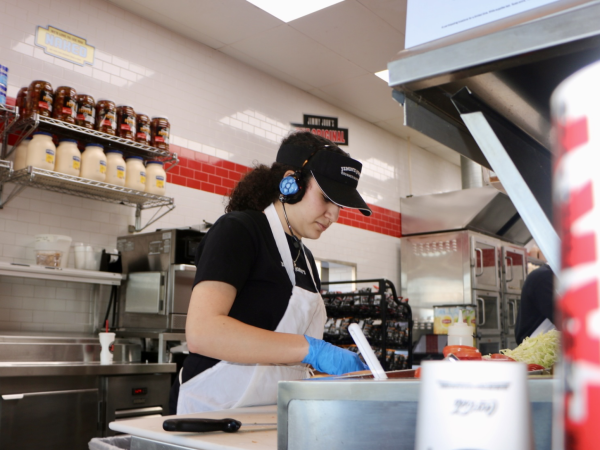
As high schoolers take their first steps into the professional world, they are introduced to many new economic concepts and responsibilities. For sophomore Emily Messiha, working her first part time job at Jimmy Johns transformed her understanding of the significance behind every purchase. She said she applied at 14 years old to learn more about financial decisions as well as to get used to having a job.
Messiha said, “Before (working), I definitely knew a bit about some economic processes, but I didn’t know the importance or value of money because I just had everything given to me. Working gives me more understanding, and I think of (purchasing) more as, ‘This costs an hour of my life,’ which makes me value it more because it’s worth my time.”
Nearly one third of teenagers ages 16 to 19 are employed with numbers fluctuating to over 40% during summer months, according to Indiana Capital Chronicle. Employment as a young person juggling school and work can pose challenges as well as provide valuable lessons.
Michelle Foutz, economics teacher and Economics Club Sponsor said having a job encouraged students to practice useful skills such as budgeting.
“Economics in a nutshell is all about decision making and allocating scarce resources,” Foutz said. “Back to budgeting- how you’re going to spend that income- a lot of people for the first time after getting their first job realize they’re going to need to think about saving now, and also how they can generate interest and what types of financial vehicles they might use in order to save.”
The skills employment introduces have major impacts on students’ financial literacy and economic independence, however, can interfere with school performance.
(Laasya Avula)
Economic literacy
Fast food and retail industries continue to dominate the primary fields for teens balancing school and work, categorizing the majority of employed highschoolers as W-2 employees. W-2 employees receive annual tax forms reporting their earnings and withheld taxes and are also eligible for employee benefits.
Junior Madeline McCrory said her experience working two jobs at Rita’s Italian Ice and as an ice hockey referee at the Carmel Ice Skadium helped expand her knowledge about the economy and paying taxes.
She said, “I definitely knew nothing about taxes before I got my job at Rita’s, and then I developed my (knowledge) after getting the job. I started to learn about paying taxes and then at the end of the year I got my returns, so I learned about that as well.”
Messiha said, “I have learned a lot. I learned what my taxes go to on my pay stub. There’s a breakdown- this amount of money goes to Social Security and this amount goes to federal income- and then I’ve learned more about taxes and how they work in general. At the end of the year, there’s a statement that I have to give to an accountant called a W-2, and I learned about why tax returns are the way they are and how filing works.”
Beyond taxes and basic paychecks, having a job introduces young people to more economic concepts such as saving, investing and opportunity cost. According to WebMD, being exposed to transactions and receiving a paycheck can make time and hard work feel more tangible, which discourages working teens from making purchases that are not worth their time.
Foutz said students often find more satisfaction when the money they use is money they earned, which encourages them to value it more.
“I think that having a job is really important in just understanding the cost of things. With my own daughter and with allowance it makes you more thoughtful about how you’re spending, when that is money that you’ve worked really hard for and you’re more careful and thoughtful about that decision making process. And then, there’s also the saving aspect too. Work is hard, and you put a lot of effort into earning that income so there are a lot more thoughtful decisions about how that money is allocated. What you’re spending it on, how much you’re spending, how much you’re saving, with a job.”
Messiha said she was reserving portions of her paycheck for savings, specifically for a car and future college payments.
“I also want to save because I’m not going to have nothing to pay for forever, so I need to have money in the future,” she said. “Every paycheck I think, ‘I’m only going to spend this much of it until like the next one rolls around so then I can allot some money just for a later time. It teaches you a lot of financial responsibility because it’s your money that you worked hard for, so it teaches you how to spend or save or just spend more responsibly. It also teaches you how to better manage your time.”
Financial independence
For the first time in their lives, employed students produce their own sources of income. Not only can they make purchases their parents might have once declined, but they now handle the entire transaction. The lessons high school students learn at work follow them throughout their lives, giving them an advantage as they enter their young adult years.
NGPF studies indicate that people who work in high school also earn higher hourly wages with fewer periods of unemployment due to the transferable economic skills they developed early on.
Foutz said, “The things you learn from working are kind of the lessons that are simplistic, but as you get older and you want to buy a house or you want to buy a new car you start to think, ‘Can I buy a new car if every day I’m spending this much money going out to eat and all of this money on Starbucks coffees? Am I going to have enough money to buy a house?’ And so it just gives you an opportunity to start thinking about budgeting and saving when you are younger.”
McCrory said she relies less on her parents to make purchases for her, and feels much more confident in her own skills handling money.
She said, “Although I still rely on them somewhat, I could probably file all my returns by myself. I think it’s super important to learn how to manage your money, learn how much of that money goes to the state and how much you get back.”
Messiha said most of her current purchases were with her own money, and she appreciated not making her parents pay for her.
“It’s definitely better to start working at a young age,” she said. “I wouldn’t want to be thrown into growing up and like having all these things handed to you and you don’t get to practice (saving). The scale is also not super serious right now because none of my current financial decisions are gonna impact like my entire life, but if I’m older and I don’t know what I’m doing with my money, then it’s super easy to spend too much.”
Foutz said, “The earlier you start thinking about saving and financial literacy, the better. I do that a lot with my daughter, and we’ll go to the store and she’ll say, ‘I want this,’ and I’ll say, ‘Well, look at how much it cost and what other things could you buy with that much money, and how much is your allowance, and how many beds would you have to make in order to be able to pay for that. The more you think about it, the more it will naturally come into you.”
Navigating school
Although working as a high school student offers many long-term benefits, it can cause significant stress while trying to manage school and work. According to the National Library of Medicine, students who work more than 20 hours per week tend to perform less well in school than those who do not. Because those students are spending more time working and less time studying, their outcomes in school are relatively worse. Contrarily, students who work 20 hours a week or less can create better habits of productivity than those who do not work.
Foutz said she has many students who work strenuous hours to help their families, which can impact the amount of studying and homework they have time to complete.
She said, “I know students who have to pay for everything, like their SAT or pay for their AP exams, have to pay for their clothes, help pay for utilities at home, help pay the rent, and I think that’s tough. That’s really hard, and that adds a lot of stress. But I think that some of those students are learning very early on some of the things that some of the other students may not learn until later.”
McCrory said, “I think that during the school year sometimes it can be kind of hard to balance it with all the homework and other extracurriculars that you have to do, but it works out eventually. I figure out what time I’m going to work, how long I’ll be there, and especially if I might end up working overtime, then I’ll do my homework around that time slot.”
When navigating how to manage her busy schedule, Messiha said it was critical for her to deliberately plan her days.
She said, “It’s definitely possible to not have enough time to do schoolwork because basically like my entire half of my weekend is taken up by my Saturday shift because it’s 8 hours and it’s like in the middle of the day, so there’s not much I do before or after. I have to be able to manage my time a lot better and because I can’t do homework or study in that eight hour period. If I know something’s going to take me a while, I try and get it started before I have my work.”