









![Cal Carmichael starting for Carmel last season. Carmichael said he wants to do everything he can to help the team win every time he steps on the mound. [Submitted: Cal Carmichael]](https://hilite.org/wp-content/uploads/2026/04/Screenshot-2026-04-13-3.40.48-PM.png)













![Review: Project Hail Mary is a visually stunning film filled with deep emotion, humor and a heartfelt partnership [MUSE]](https://hilite.org/wp-content/uploads/2026/05/PHM2-2.jpg)
![Review: “Iron Lung” exemplifies the success of suspense [MUSE]](https://hilite.org/wp-content/uploads/2026/04/IronLung-1200x675.webp)
![Review: New F1 regulations prove to be anything but boring [MUSE]](https://hilite.org/wp-content/uploads/2026/04/2-1-1200x675.avif)
![“‘Wuthering Heights’” wasn’t a bad movie—it just wasn’t anything like the book [MUSE]](https://hilite.org/wp-content/uploads/2026/02/wutheringh-960x1200.webp)
![Review: Season 5 of “Stranger Things" delivered the perfect ending despite major mistakes [MUSE]](https://hilite.org/wp-content/uploads/2026/01/ems-810x1200.jpg)
![Review: “Zootopia 2” is a stunning and engaging sequel that elevates the universe [MUSE]](https://hilite.org/wp-content/uploads/2025/12/bjUWGw0Ao0qVWxagN3VCwBJHVo6-800x1200.jpg)
![Review: I have no critiques: “Demon Slayer: Infinity Castle” is amazing [MUSE]](https://hilite.org/wp-content/uploads/2025/12/MV5BOGQ3YWUzYjEtMTJiYy00ZjQ0LWI0YjktYjhiNGVhNGExYTM3XkEyXkFqcGc@._V1_FMjpg_UX1000_-797x1200.jpg)
![Review: Learning to say “I” with “The Fountainhead” [MUSE]](https://hilite.org/wp-content/uploads/2025/12/The_Fountain_Head_1943_1st_ed_-_Ayn_Rand.jpg)
![Review: Java House Fall Menu [MUSE]](https://hilite.org/wp-content/uploads/2025/12/Screenshot-2025-12-01-at-15.10.19-1200x618.png)
![Review: "When I Fly Towards You", cute, uplifting youth drama [MUSE]](https://hilite.org/wp-content/uploads/2023/09/When-I-Fly-Towards-You-Chinese-drama.png)
![Postcards from Muse: Hawaii Travel Diary [MUSE]](https://hilite.org/wp-content/uploads/2023/09/My-project-1-1200x1200.jpg)




!["Wicked" poster controversy sparks a debate about the importance of accuracy versus artistic freedom [opinion]](https://hilite.org/wp-content/uploads/2024/11/riva-perspective-cover-1200x471.jpg)
The recently released movie poster for the highly anticipated “Wicked” film has sparked a debate that goes far beyond design aesthetics. The controversy began when a fan posted an edited version of the “Wicked” movie poster by altering colors and details to more closely match the iconic look of the original stage production poster. This reimagining quickly ignited a flurry of debate, with some fans applauding the tribute to Broadway’s classic aesthetic, while others defended the movie’s fresh take as a natural progression of the material. While the fan’s attempt to honor the musical’s legacy was benevolent, many, including actress Cynthia Erivo, found it deeply disrespectful. According to Forbes, Erivo said, “Our poster is an homage, not an imitation. To edit my face and hide my eyes is to erase me, and that is just deeply hurtful.”
This debate raises a larger question: When adapting a work for the screen or stage, should the adaptation prioritize accuracy to the original source, or should it be free to explore new creative avenues? Though this question may seem trivial, it actually carries significant weight with a rather nuanced answer.
Adaptations based on books, plays or other forms of literature tend to have more room for interpretation, which often leads to noticeable discrepancies between the source material and its adaptation. For example, the novel Les Misérables, one of the most beloved and widely adapted stories in literary history, has undergone significant changes throughout its various adaptations, particularly when it comes to the fate of key characters after their deaths. In the stage musicals, films and even televised versions, there are many inconsistencies from Victor Hugo’s original novel, including changes to character arcs, plot points and themes. These deviations often stem from the challenges of translating literature, with its complex narrative and thematic layers, into a timed medium like film or theater.
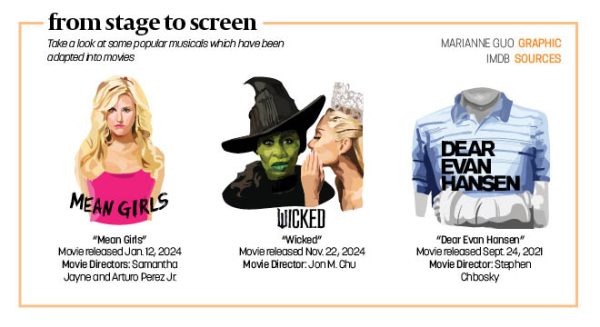
However, the boundaries of adaptations aren’t always so clear. In musical adaptations, where the blend of music, visuals and performance is crucial to the overall experience, the decision to either remain true to the original design or take creative liberties becomes a more delicate choice. In the case of “Wicked,” the Broadway production is visually defined by its larger-than-life set pieces, vibrant costumes and flamboyant artistic choices. The decision to create a movie that differs from these elements, rather than replicating them, is not inherently disrespectful—though some may argue that it is too far from the spirit of the source.
In a time where adaptations are often scrutinized for their faithfulness or lack thereof to the original, there is a valid argument for both sides of the debate. On one hand, adaptations can honor the source material by staying true to its core elements, preserving the integrity of the original creation. On the other hand, films and musicals are mediums in their own right and deserve the space to create something new, bringing something novel to the table while still taking into account the essence of the original work.
Ultimately, the question of accuracy versus artistic freedom in adaptations comes down to a matter of intention and respect; both for the original creators and for the new team interpreting the story for a different audience. As “Wicked” and other adaptations continue to evolve, it will be interesting to see how the boundaries of creativity and tradition are navigated.
The views in this column do not necessarily reflect the views of the HiLite staff. Reach Riva Jain at [email protected].