


























![Cal Carmichael starting for Carmel last season. Carmichael said he wants to do everything he can to help the team win every time he steps on the mound. [Submitted: Cal Carmichael]](https://hilite.org/wp-content/uploads/2026/04/Screenshot-2026-04-13-3.40.48-PM.png)






























![Review: Project Hail Mary is a visually stunning film filled with deep emotion, humor and a heartfelt partnership [MUSE]](https://hilite.org/wp-content/uploads/2026/05/PHM2-2.jpg)
![Review: “Iron Lung” exemplifies the success of suspense [MUSE]](https://hilite.org/wp-content/uploads/2026/04/IronLung-1200x675.webp)
![Review: New F1 regulations prove to be anything but boring [MUSE]](https://hilite.org/wp-content/uploads/2026/04/2-1-1200x675.avif)
![“‘Wuthering Heights’” wasn’t a bad movie—it just wasn’t anything like the book [MUSE]](https://hilite.org/wp-content/uploads/2026/02/wutheringh-960x1200.webp)
![Review: Season 5 of “Stranger Things" delivered the perfect ending despite major mistakes [MUSE]](https://hilite.org/wp-content/uploads/2026/01/ems-810x1200.jpg)
![Review: “Zootopia 2” is a stunning and engaging sequel that elevates the universe [MUSE]](https://hilite.org/wp-content/uploads/2025/12/bjUWGw0Ao0qVWxagN3VCwBJHVo6-800x1200.jpg)
![Review: I have no critiques: “Demon Slayer: Infinity Castle” is amazing [MUSE]](https://hilite.org/wp-content/uploads/2025/12/MV5BOGQ3YWUzYjEtMTJiYy00ZjQ0LWI0YjktYjhiNGVhNGExYTM3XkEyXkFqcGc@._V1_FMjpg_UX1000_-797x1200.jpg)
![Review: Learning to say “I” with “The Fountainhead” [MUSE]](https://hilite.org/wp-content/uploads/2025/12/The_Fountain_Head_1943_1st_ed_-_Ayn_Rand.jpg)
![Review: Java House Fall Menu [MUSE]](https://hilite.org/wp-content/uploads/2025/12/Screenshot-2025-12-01-at-15.10.19-1200x618.png)
![Review: "When I Fly Towards You", cute, uplifting youth drama [MUSE]](https://hilite.org/wp-content/uploads/2023/09/When-I-Fly-Towards-You-Chinese-drama.png)
![Postcards from Muse: Hawaii Travel Diary [MUSE]](https://hilite.org/wp-content/uploads/2023/09/My-project-1-1200x1200.jpg)











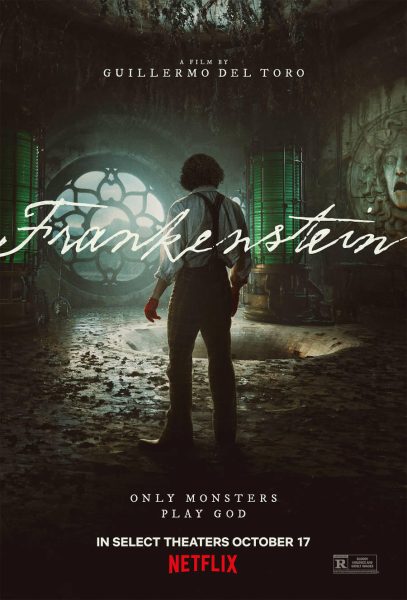
Spoiler warning: This review contains spoilers for “Frankenstein” (2025) and Frankenstein by Mary Shelley
As much as he is known for the movies he has made, Guillermo del Toro is possibly just as famous for the ones he has not. From “The Hobbit,” which was handed off to Peter Jackson and devolved into the CGI-ridden, convoluted mess of a trilogy we know it as today, to “At the Mountains of Madness,” another adaptation canceled by Universal, which was unwilling to finance the bleak, big-budget, R-rated picture del Toro had dreamed up. As a filmmaker celebrated for his dark, mythical visual style, fans can only fantasize about his iterations of these works.
For del Toro, “Frankenstein” had to be done. Described as his “Bible” when he read it at 11 years old, the filmmaker has attempted to produce an adaptation for 25 years. It’s nearly a match made in heaven—what better director to take on Mary Shelley’s classic than the one who can nearly always find beauty in the grotesque? Finally free from the gates of development hell, “Frankenstein” saw a limited release on Oct. 17 and a Netflix release on Nov. 7.
In the Arctic, “Frankenstein” opens with sailors stumbling upon Victor Frankenstein (Oscar Isaac) alone and dying on an ice cap. Upon rescuing Victor, he recounts his life story to Captain Anderson (Lars Mikkelsen).
Traumatized by his mother’s death and the cruelty of his father, a young Victor becomes obsessed with death. Decades of study and experimentation later, he presents the partial reanimation of a corpse at the College of Surgeons. Horrified by this occult demonstration, the council expels him. However, arms merchant Henrich Harlander (Christoph Waltz)—uncle to Elizabeth Harlander (Mia Goth), fianceé to Victor’s younger brother William’s (Felix Kammerer)—is intrigued by Victor’s ideas, and decides to fund his research. Waltz, whose character ultimately becomes another casualty of Victor’s destructive tendencies, is a fine addition, in a mostly brief, one-note performance.
The way the film depicts Victor creating the Creature is akin to Michelangelo painting the Sistine Chapel. Del Toro treats Victor not only as a mad scientist, but as an artist—from his anatomical wax models and notebook sketches to the meticulous trimming and sewing of body parts to form the perfect creature. Set to Alexandre Desplat’s fantastical score, his creation is miraculous—a fairytale-worthy moment in a film otherwise occupied by tragedy.
Once the Creature comes to life, none of the love Victor poured into creating him is spent caring for him. He refuses to let the Creature touch him, and chains him in the basement. Isaac’s portrayal displays an incredible range, following Victor’s life from a young, optimistic scientist to the jaded, guilt-ridden man he becomes in the fallout of the Creature’s making.
A visit from William and Elizabeth, prompted by Henrich’s debilitating illness, pushes Victor over the edge. Victor, enamored with Elizabeth, considers her disapproval of his work. Elizabeth, in another deviation from the source material, foils Victor in her un-controlling nature, love of the natural world and empathy for the Creature. Disturbed, Victor sets fire to his tower. This turning point marks the end of Victor’s story, shifting the narrative to the Creature, who escapes his prison, and washes ashore on rocks of a nearby town. The Creature takes solace by hiding in the walls of a local mill family, listening to their conversations, learning the ways of human connection and secretly helping with outdoor labor, which earns him the title as “The Spirit of the Forest.” Eventually the patriarch of the family takes him in, teaching him to read through books, including John Milton’s epic poem Paradise Lost. Milton’s work, a foundational text for Shelley, is one of the many theological allusions in the film, as Victor dreams of Lucifer, an archangel who rebels against God out of pride and ambition—paralleling Victor’s own descent.
Jacob Elordi’s depiction of the Creature is so remarkable it’s shocking he wasn’t initially slated to take on the role. Elordi embodies the character with both a terrifying, foreboding presence—thanks in part to metamorphic prosthetics and his naturally tall frame—and the wide-eyed wonder and sensitivity of a child. His Creature hobbles around after being unchained for the first time like a baby taking his first steps in one moment, then brutally annihilates a huntsman in the next.
Developing his own autonomy, the Creature returns to the castle where he was made, learns the truth of his existence, and confronts Victor at William’s wedding. After asking Victor to create a companion—a hasty, half-hearted addition from the original text—the Creature attacks Victor, ultimately leading to the deaths of William and Elizabeth. William’s parting words to Victor, “You are the monster,” lack so much subtlety, it’s reminiscent of Netflix’s previous demands for writers to accommodate for “second-screen viewers,” helping distracted audiences more clearly get the message. Del Toro has built a career off of sympathetic monsters, but the trouble here is the lack of balance. Both monsters in their own ways, Victor is reserved far less empathy than the Creature, a departure from the novel which removes the layers of nuance Shelley crafted.
A visual feast, every frame of “Frankenstein” could be a painting. From the breathtaking lighting to the classic gothic, hand-curated sets del Toro is known for, the choices here are deliberate, going beyond mere aesthetics. The most obvious element played with is color, red being the primary one representative of Victor’s mother, whose death is the catalyst for his scientific exploration of reanimation. Costumes like Elizabeth’s wedding dress, adorned with bandage-like sleeves, evocative of the Creature’s initial clothes, are a treat for keen-eyed viewers. The wide lens is a half-successful effort—the scale of the sets and set pieces is certainly commendable—but most of the cinematography is uninspired, and this choice only exacerbates the glossy CGI landscapes. Practical effects, when present, are excellent, and give the film the more gritty feel some viewers may find lacking.
While Shelley’s text ends tragically, Victor dying after chasing the Creature and the Creature burning himself to death, del Toro opts for a more hopeful, yet hurried conclusion. The Creature forgives Victor, poetically walking off into the sunrise, choosing life after being denied it by his creator.
As much as del Toro intended for “Frankenstein” to be an authentic representation of Shelley’s original work, it is evident elements of the story are reworked to fit his vision, from the heavy emphasis on generational trauma to the romantic ending. Scrutiny of adaptations is inevitable, and discussions surrounding such changes should be welcomed, especially for timeless works like Frankenstein. On what basis these changes are made and how these changes alter meaning, is a question both adaptors and viewers must contend with. Del Toro’s answer? “A text is like a house; you have to move in.”
On this blog, members of the Carmel High School chapter of the Quill and Scroll International Honorary Society for High School Journalists (and the occasional guest writer) produce curations of all facets of popular culture, from TV shows to music to novels to technology. We hope our readers always leave with something new to muse over. Click here to read more from MUSE.