




























![Cal Carmichael starting for Carmel last season. Carmichael said he wants to do everything he can to help the team win every time he steps on the mound. [Submitted: Cal Carmichael]](https://hilite.org/wp-content/uploads/2026/04/Screenshot-2026-04-13-3.40.48-PM.png)





































![Review: Project Hail Mary is a visually stunning film filled with deep emotion, humor and a heartfelt partnership [MUSE]](https://hilite.org/wp-content/uploads/2026/05/PHM2-2.jpg)
![Review: “Iron Lung” exemplifies the success of suspense [MUSE]](https://hilite.org/wp-content/uploads/2026/04/IronLung-1200x675.webp)
![Review: New F1 regulations prove to be anything but boring [MUSE]](https://hilite.org/wp-content/uploads/2026/04/2-1-1200x675.avif)
![“‘Wuthering Heights’” wasn’t a bad movie—it just wasn’t anything like the book [MUSE]](https://hilite.org/wp-content/uploads/2026/02/wutheringh-960x1200.webp)
![Review: Season 5 of “Stranger Things" delivered the perfect ending despite major mistakes [MUSE]](https://hilite.org/wp-content/uploads/2026/01/ems-810x1200.jpg)
![Review: “Zootopia 2” is a stunning and engaging sequel that elevates the universe [MUSE]](https://hilite.org/wp-content/uploads/2025/12/bjUWGw0Ao0qVWxagN3VCwBJHVo6-800x1200.jpg)
![Review: I have no critiques: “Demon Slayer: Infinity Castle” is amazing [MUSE]](https://hilite.org/wp-content/uploads/2025/12/MV5BOGQ3YWUzYjEtMTJiYy00ZjQ0LWI0YjktYjhiNGVhNGExYTM3XkEyXkFqcGc@._V1_FMjpg_UX1000_-797x1200.jpg)
![Review: Learning to say “I” with “The Fountainhead” [MUSE]](https://hilite.org/wp-content/uploads/2025/12/The_Fountain_Head_1943_1st_ed_-_Ayn_Rand.jpg)
![Review: Java House Fall Menu [MUSE]](https://hilite.org/wp-content/uploads/2025/12/Screenshot-2025-12-01-at-15.10.19-1200x618.png)
![Review: "When I Fly Towards You", cute, uplifting youth drama [MUSE]](https://hilite.org/wp-content/uploads/2023/09/When-I-Fly-Towards-You-Chinese-drama.png)
![Postcards from Muse: Hawaii Travel Diary [MUSE]](https://hilite.org/wp-content/uploads/2023/09/My-project-1-1200x1200.jpg)









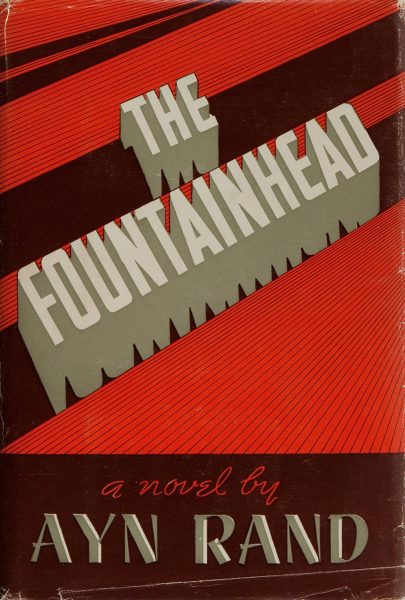 The epitome of the anti-socialist manifesto, written by the darling of the conservatives Ayn Rand, The Fountainhead champions the idea and rights of the individual over the will of the collective. Going into the novel, I didn’t realize I was delving into a school of thought that so ardently defends the virtue of capitalism; however, despite my own personal beliefs, I found myself compelled by The Fountainhead’s celebration of individuality as it critiques society’s tendency to suppress the voice and values of the self. For me there are two fundamentally linked yet separable facets of Rand’s most accoladed work: The social and the political aspect. The distinction between the two lies with the role of the public, the critical masses as it pertains to systems of economics, public opinion, altruism, and above all, the individual. As Rand herself said, the premise of the novel is “individualism versus collectivism, not in politics, but in a man’s soul.”
In a political sense, socialism advocates collective ownership and social welfare over monetary gain for the top strata of society. While increased social welfare is, in my opinion, a holistically positive sentiment, one to reduce the social stratification so pervasive in our society, socialism prioritizes the collective voice over the individual. In a societal sense, prioritizing the masses over the individual leaves one susceptible to control by outside forces. In The Fountainhead, this aspect is exhibited through the antagonist Ellsworth Toohey, a columnist on the fictional newspaper, the New York Banner. By devaluing a human’s rational egoism, leaving a person devoid of personal values, of the ability for individual thought, only a shell of the opinions of people around, one becomes the worst kind of “second hander,” (a person who lives only in the eyes of their beholders).
At its core, The Fountainhead is a love story—a romance between an artist and his art, an architect and his buildings. Howard Roark, the story’s protagonist, is a deeply prideful individual—he lives for no one but himself and his craft. Roark is almost prideful to a fault, a man who reveres mankind, who believes that a person is nothing without their capacity to create freely and think freely. He builds monuments to what he believes mankind to be: noble in its pursuit for happiness—a purportedly selfish endeavor. Rand’s philosophy of objectivism embraces this selfishness as man’s purpose in life, seeing individual, rational thought and creation to be a supreme exaltation of the inherent goodness of man’s selfhood.
The novel is centered on a few characters: Howard Roark, Rand’s idea of the quintessential man; Peter Keating, the complete antithesis to Roark, a man devoid of originality and personal values; Ellsworth Toohey, a character who embodies the voice of the collective, and seeks to crush a person’s sense of self; Dominique Francon, a woman who is Roark’s match, yet sabotages others and herself as she believes the individual can never prevail when met with the force of the critical masses; and Gail Wynand, the powerful owner of the fictional papers, the New York Banner. Through these characters, Rand expertly weaves an allegorical commentary about the fight of an individual against the overwhelming collective opinion.
Throughout the course of the novel, Roark faced numerous hardships, edged public ruin at the hands of those who desired power over the collective, and yet his individualism—his stony indifference when met with the scrutinizing eyes of onlookers—prevailed.
After reading the book, I feel as though my worldview has been altered inexplicably. A quote from the book reads: “To say ‘I love you’ one must first be able to say I.” The Fountainhead shows that a man unable to live for himself is ultimately unable to live for anything else, not even that which he loves. A man who does not value himself or his principles is a man who is not truly free. In my lifetime I hope that I will be able to find the courage to live for myself as Roark does, to love something so deeply, to be so principled that the views of people are of no importance to me. That to be a “second hander,” living for others, is man’s worst fate. On the other hand, to live for oneself, to think for oneself, and to create for oneself is the true exaltation of man’s nobility.
Not only do the themes and characters of The Fountainhead resonate deeply with me, but Rand’s style of writing is utterly exquisite. Not a word was wasted, in both the dialogues and the monologues. Though long and drawn out at times, Rand’s writing is raw and deeply emotional.
It is actually erroneous to say The Fountainhead is the cornerstone of conservatism, because it is not, and to classify it as such goes against the very principles described by the book. In fact, Rand broke from traditional conservatism in many key ways, atheism and ethics being notable among them. It is deeply incorrect to say The Fountainhead is solely a commentary on political and social objectivism because it is much more than that. The Fountainhead is a celebration of the individual, and a testament to humankind’s capacity to create and to think freely. Rand’s ability to capture and hold the reader’s attention coupled with the characters and theme of the book makes The Fountainhead a delight to experience. With all certainty, The Fountainhead is a remarkable novel I plan to revisit time and time throughout the course of my life.
On this blog, members of the Carmel High School chapter of the Quill and Scroll International Honorary Society for High School Journalists (and the occasional guest writer) produce curations of all facets of popular culture, from TV shows to music to novels to technology. We hope our readers always leave with something new to muse over. Click here to read more from MUSE.