









![Cal Carmichael starting for Carmel last season. Carmichael said he wants to do everything he can to help the team win every time he steps on the mound. [Submitted: Cal Carmichael]](https://hilite.org/wp-content/uploads/2026/04/Screenshot-2026-04-13-3.40.48-PM.png)













![Review: Project Hail Mary is a visually stunning film filled with deep emotion, humor and a heartfelt partnership [MUSE]](https://hilite.org/wp-content/uploads/2026/05/PHM2-2.jpg)
![Review: “Iron Lung” exemplifies the success of suspense [MUSE]](https://hilite.org/wp-content/uploads/2026/04/IronLung-1200x675.webp)
![Review: New F1 regulations prove to be anything but boring [MUSE]](https://hilite.org/wp-content/uploads/2026/04/2-1-1200x675.avif)
![“‘Wuthering Heights’” wasn’t a bad movie—it just wasn’t anything like the book [MUSE]](https://hilite.org/wp-content/uploads/2026/02/wutheringh-960x1200.webp)
![Review: Season 5 of “Stranger Things" delivered the perfect ending despite major mistakes [MUSE]](https://hilite.org/wp-content/uploads/2026/01/ems-810x1200.jpg)
![Review: “Zootopia 2” is a stunning and engaging sequel that elevates the universe [MUSE]](https://hilite.org/wp-content/uploads/2025/12/bjUWGw0Ao0qVWxagN3VCwBJHVo6-800x1200.jpg)
![Review: I have no critiques: “Demon Slayer: Infinity Castle” is amazing [MUSE]](https://hilite.org/wp-content/uploads/2025/12/MV5BOGQ3YWUzYjEtMTJiYy00ZjQ0LWI0YjktYjhiNGVhNGExYTM3XkEyXkFqcGc@._V1_FMjpg_UX1000_-797x1200.jpg)
![Review: Learning to say “I” with “The Fountainhead” [MUSE]](https://hilite.org/wp-content/uploads/2025/12/The_Fountain_Head_1943_1st_ed_-_Ayn_Rand.jpg)
![Review: Java House Fall Menu [MUSE]](https://hilite.org/wp-content/uploads/2025/12/Screenshot-2025-12-01-at-15.10.19-1200x618.png)
![Review: "When I Fly Towards You", cute, uplifting youth drama [MUSE]](https://hilite.org/wp-content/uploads/2023/09/When-I-Fly-Towards-You-Chinese-drama.png)
![Postcards from Muse: Hawaii Travel Diary [MUSE]](https://hilite.org/wp-content/uploads/2023/09/My-project-1-1200x1200.jpg)





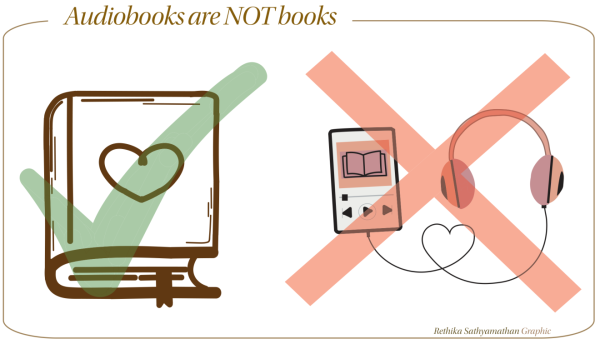
I would like to preface this column by stating that I love audiobooks. I listen to them while driving, folding laundry, or when I try to romanticize my daily walks. They make literature more accessible and honestly, more fun for those who struggle with sitting and reading an entire book. Audiobooks have a place, and are valuable. But liking audiobooks and calling them “reading” are two different things.
Reading, at its core, is an active cognitive process. According to Lexia, when you read a physical book or even an e-book, your brain is doing a multitude of things at once: decoding the words, controlling your pacing, visualizing scenes and making meaning from the text. Listening, on the other hand, is more of a passive intake. The story continues to move forward whether you are fully focused or not.
This difference matters more than what meets the eye. Research consistently shows that people are more likely to zone out or miss details when listening compared to reading visually. I remember listening to The Poppy Wars, and when I read an analysis of a chapter later, I realized that I had completely missed some of the key details. When reading, if a sentence does not make sense, you stop, go back and reread. With audiobooks, unless you are actively rewinding (which most people do not do every time their attention shifts), those details are gone. The narrator of your story keeps going and comprehension gaps can pile up relatively quietly.
Audiobooks also make multitasking tempting, and multitasking is not your brain’s strong suit. Most people, including me, listen while doing something else. Even if you feel focused, your brain is splitting its attention. Reading a physical book does not allow for that same illusion. You cannot really read while doing three other things, forcing you to engage with the text deeper.
Another key difference between reading and listening is interpretation. When you read, you are responsible for making your own meanings out of the text by imagining tone, emphasis and emotion. With audiobooks, that work is partially done for you. The narrator’s voice shapes how characters sound and how events unravel, ultimately guiding your interpretation. As people stop engaging directly with texts, they lose the ability to interpret it on their own. Reading forces you to slow down and sit with the language as it is, without someone else telling you how it should be understood.
None of this means audiobooks are bad. They are an incredible tool for accessibility, especially for people with visual impairments, learning differences, or anything else that could make traditional reading difficult. They absolutely count as consuming literature, but they do not count as reading in the traditional sense.
If we say audiobooks and reading are the same thing, we flatten the meaning of reading itself. Word choice matters. Reading is a skill that strengthens focus, comprehension and critical thinking in a way listening does not replicate. That does not mean one should be seen as more superior; they are just cognitively different.
So yes, love your audiobooks. Recommend them. Use them. But we should be honest about what they are. Listening to a book is not the same as reading one, and this distinction is worth keeping.