



















![Cal Carmichael starting for Carmel last season. Carmichael said he wants to do everything he can to help the team win every time he steps on the mound. [Submitted: Cal Carmichael]](https://hilite.org/wp-content/uploads/2026/04/Screenshot-2026-04-13-3.40.48-PM.png)


























![Review: Project Hail Mary is a visually stunning film filled with deep emotion, humor and a heartfelt partnership [MUSE]](https://hilite.org/wp-content/uploads/2026/05/PHM2-2.jpg)
![Review: “Iron Lung” exemplifies the success of suspense [MUSE]](https://hilite.org/wp-content/uploads/2026/04/IronLung-1200x675.webp)
![Review: New F1 regulations prove to be anything but boring [MUSE]](https://hilite.org/wp-content/uploads/2026/04/2-1-1200x675.avif)
![“‘Wuthering Heights’” wasn’t a bad movie—it just wasn’t anything like the book [MUSE]](https://hilite.org/wp-content/uploads/2026/02/wutheringh-960x1200.webp)
![Review: Season 5 of “Stranger Things" delivered the perfect ending despite major mistakes [MUSE]](https://hilite.org/wp-content/uploads/2026/01/ems-810x1200.jpg)
![Review: “Zootopia 2” is a stunning and engaging sequel that elevates the universe [MUSE]](https://hilite.org/wp-content/uploads/2025/12/bjUWGw0Ao0qVWxagN3VCwBJHVo6-800x1200.jpg)
![Review: I have no critiques: “Demon Slayer: Infinity Castle” is amazing [MUSE]](https://hilite.org/wp-content/uploads/2025/12/MV5BOGQ3YWUzYjEtMTJiYy00ZjQ0LWI0YjktYjhiNGVhNGExYTM3XkEyXkFqcGc@._V1_FMjpg_UX1000_-797x1200.jpg)
![Review: Learning to say “I” with “The Fountainhead” [MUSE]](https://hilite.org/wp-content/uploads/2025/12/The_Fountain_Head_1943_1st_ed_-_Ayn_Rand.jpg)
![Review: Java House Fall Menu [MUSE]](https://hilite.org/wp-content/uploads/2025/12/Screenshot-2025-12-01-at-15.10.19-1200x618.png)
![Review: "When I Fly Towards You", cute, uplifting youth drama [MUSE]](https://hilite.org/wp-content/uploads/2023/09/When-I-Fly-Towards-You-Chinese-drama.png)
![Postcards from Muse: Hawaii Travel Diary [MUSE]](https://hilite.org/wp-content/uploads/2023/09/My-project-1-1200x1200.jpg)









Junior Olivia Deloney said she still remembers at a young age being mocked for her natural hair texture–dark, coiled curls. Since then, she said, moments like those have followed her throughout life, and while not overtly attacking her, Deloney said the words still felt hateful.
She said, “Hate speech to me is when you shame people for things out of their control; making someone feel less than because of their race, hair texture or culture. Hate speech, and just racist or sexist comments, have been something that my friends and I have experienced a lot, but in reality, (hate speech) is just a sad, but common fact of the daily experience of people of color (POC).”
Do you know your First Amendment rights?
There was an error. Please try again.
8 Total Questions

Deloney is not alone in her experience with hate speech–in fact, according to a study conducted by the National Institute of Health, of all the minority participants surveyed, most had experienced at least one incident of hateful speech. The surge of politically polarizing legislation and the widespread mobilization of extremist groups both on and off social media, has allowed overt hate speech to become more commonplace. The frequency of such behaviors have contributed to the growing normalization of hate speech, and with this the perpetuation of hateful sentiments in public forums.
On Aug. 16, a group of neo-nazis clad in all black clothing carried flags on which the nazi swastika was emblazened, chanted “white power” as they marched around Monument Circle in Indianapolis. According to James Ziegler, AP African American Studies teacher, this form of symbolic hate speech, though not directly inciting violence, served to perpetuate fear and distrust in the community, and in neighboring communities: seeking to divide on the basis of race, culture and ethnicity.
Ziegler said, “The neo-nazi rally in mid-August illustrates the extent of white nationalist sentiment that remains pervasive in our culture. I think the fact that we have avowed hate groups that are increasingly emboldened to participate in these public displays is a really troubling sign for us as a nation, and speaks to the rhetoric that infects our public discourse. It illustrates how much progress we have left as a country to create more diverse and equitable spaces that allow everybody to express themselves and allow their identities to be acknowledged.”
Deloney echoed this sentiment, expressing her belief that hate speech perpetuates a detrimental perspective of demonizing diversity, favoring cultural homogeneity instead.
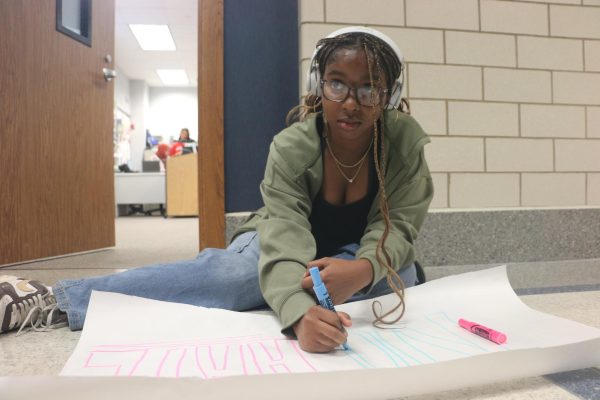
(Shawn Feng)
She said, “America was founded upon diversity and it is really heartbreaking to see this widespread pushback against the diversity that has made this country so great. The neo-nazi protest downtown just emphasized how much progress we still have to make as a society when it comes to acceptance and mitigating hate speech. It was so heartbreaking to see.”
According to junior Manha Islam, there are other forms of hate speech, though some are not as overt as the neo-nazi rally in Indianapolis. Islam said even casual forms of exclusion under the pretense of a joke can be just as damaging.
“When someone says something racist and follows up with ‘it’s not that deep’ or ‘it was just a joke’ it is actually really harmful even though it may not seem like it. It definitely impacts peoples’ mental health.”
Islam said this normalization of hate speech is rarely noticed because it seldom crosses the clear boundaries of what is right and what is wrong, but despite this, it still shapes the lives of minority students.
She said, “I’ve been in situations where someone says something clearly racist and politically incorrect, but it was under the guise of a joke. Sometimes when I call them on it, they just play it off as a joke, and that is what is really concerning. I don’t think people realize they’re saying something harmful or perpetuating a harmful stereotype.”
Islam also emphasized the emotional toll such remarks can take, even when they are brushed aside as humor.
“When people constantly minimize your identity or make you the joke itself, it sort of makes you doubt yourself and your culture,” she said.
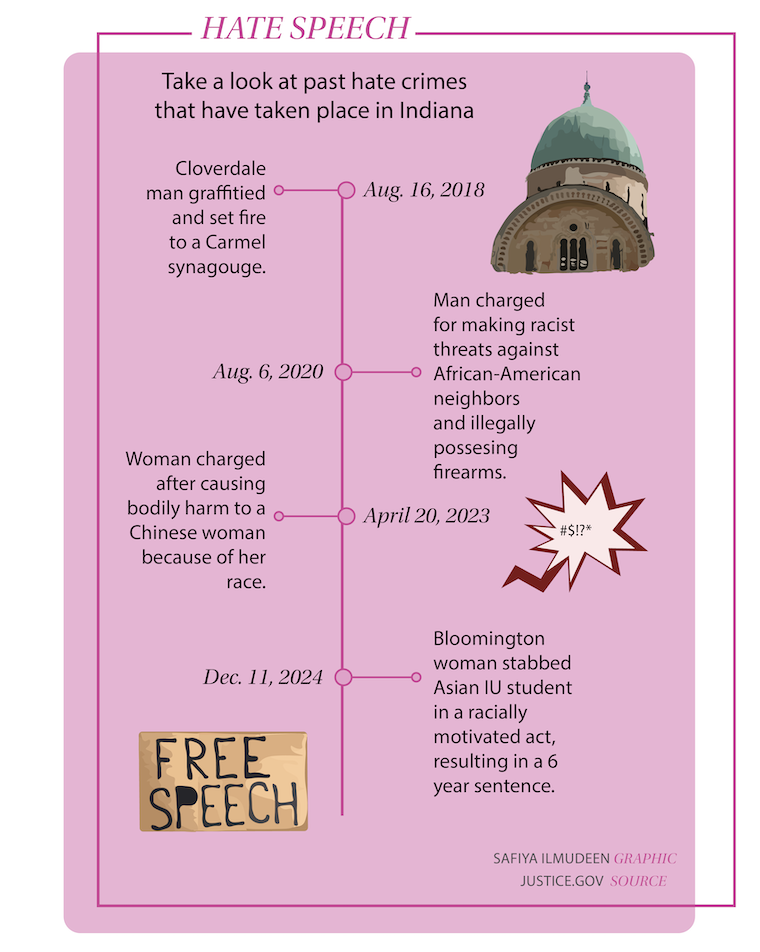
Experts agree that this kind of “everyday hate speech” can be just as damaging as large-scale displays of prejudice. According to the American Psychological Association, exposure to repeated derogatory comments—whether direct or indirect—can lead to heightened anxiety, depression, and feelings of alienation, particularly among young people.
For both Ziegler and Deloney, this underscores the importance of schools–teachers, students, and administrators–in addressing these issues head-on.
Ziegler said, “We have to ensure that hate speech, racism, and sexism at school is met with proper disciplinary action. Youth should have to go through some sort of restorative justice program–discipline coupled with education. From the outset, to foster a healthy and equitable learning environment for my students, I set very clear standards. Especially the nature of social studies is such that we will have lots of discussions about controversial topics. I want everyone in my room to feel safe, to feel included, and to feel welcome. It is important to disagree and maintain civil discourse.”
Deloney added that it is not just the responsibility of educators and school administrators to ensure that hate speech and harmful rhetoric does not permeate through the student body and the school culture. She said, “I think student groups are one of the most effective ways to curtail hate speech. If just one group of students stopped and reflected on how they interact with people, it could make a giant chain of improvement in fostering love and equality in others.”