





















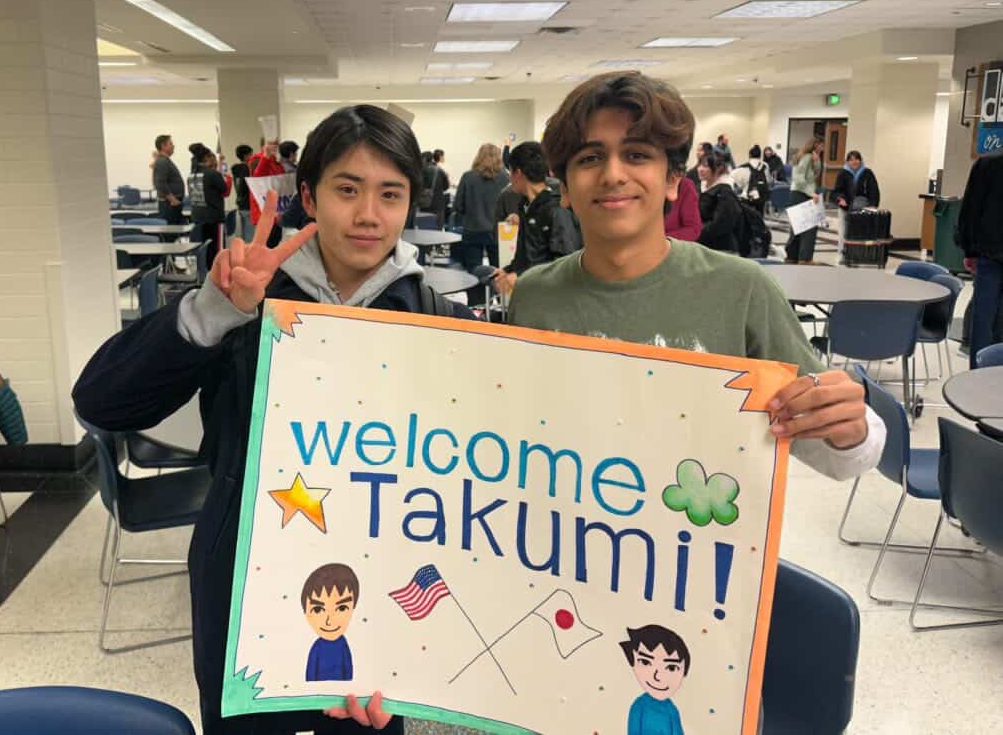






![Cal Carmichael starting for Carmel last season. Carmichael said he wants to do everything he can to help the team win every time he steps on the mound. [Submitted: Cal Carmichael]](https://hilite.org/wp-content/uploads/2026/04/Screenshot-2026-04-13-3.40.48-PM.png)





































![Review: Project Hail Mary is a visually stunning film filled with deep emotion, humor and a heartfelt partnership [MUSE]](https://hilite.org/wp-content/uploads/2026/05/PHM2-2.jpg)
![Review: “Iron Lung” exemplifies the success of suspense [MUSE]](https://hilite.org/wp-content/uploads/2026/04/IronLung-1200x675.webp)
![Review: New F1 regulations prove to be anything but boring [MUSE]](https://hilite.org/wp-content/uploads/2026/04/2-1-1200x675.avif)
![“‘Wuthering Heights’” wasn’t a bad movie—it just wasn’t anything like the book [MUSE]](https://hilite.org/wp-content/uploads/2026/02/wutheringh-960x1200.webp)
![Review: Season 5 of “Stranger Things" delivered the perfect ending despite major mistakes [MUSE]](https://hilite.org/wp-content/uploads/2026/01/ems-810x1200.jpg)
![Review: “Zootopia 2” is a stunning and engaging sequel that elevates the universe [MUSE]](https://hilite.org/wp-content/uploads/2025/12/bjUWGw0Ao0qVWxagN3VCwBJHVo6-800x1200.jpg)
![Review: I have no critiques: “Demon Slayer: Infinity Castle” is amazing [MUSE]](https://hilite.org/wp-content/uploads/2025/12/MV5BOGQ3YWUzYjEtMTJiYy00ZjQ0LWI0YjktYjhiNGVhNGExYTM3XkEyXkFqcGc@._V1_FMjpg_UX1000_-797x1200.jpg)
![Review: Learning to say “I” with “The Fountainhead” [MUSE]](https://hilite.org/wp-content/uploads/2025/12/The_Fountain_Head_1943_1st_ed_-_Ayn_Rand.jpg)
![Review: Java House Fall Menu [MUSE]](https://hilite.org/wp-content/uploads/2025/12/Screenshot-2025-12-01-at-15.10.19-1200x618.png)
![Review: "When I Fly Towards You", cute, uplifting youth drama [MUSE]](https://hilite.org/wp-content/uploads/2023/09/When-I-Fly-Towards-You-Chinese-drama.png)
![Postcards from Muse: Hawaii Travel Diary [MUSE]](https://hilite.org/wp-content/uploads/2023/09/My-project-1-1200x1200.jpg)











Recently, my Instagram feed has been inundated by political media: influencers, politicians and even friends reacting to the death of conservative activist Charlie Kirk. Amid this surge of political content, I noted that reactions to his assassination ranged widely, revealing a spectrum of responses. Some mourned his death, others pointed out the irony of his shooting, and some outright celebrated it.
Many Democratic lawmakers publicly condemned the violence and offered condolences to Kirk’s loved ones, stating that “political violence does not belong in a democracy.” Many prominent Republicans, on the other hand, denounced his killing as a political assassination, and demanded harsh retribution for the left. Some influencers posted polarizing statements mocking Kirk’s death and the notion of political violence in general, tweeting, “Do Trump next,” while others wrote emotional poetry that mourned his passing, framing him as a martyr for conservative ideals.
In no way do I justify the harmful rhetoric Kirk perpetuated through his platform, nor do I excuse any celebration of his death. But beyond politics, the heterogeneous response to Kirk’s assassination reveals something critical about our society: the selective application or even outright lack of empathy. There are not many things I am completely sure of, but this is one of them: morals and human decency are not political and will never be political. They are universal principles, rooted in our shared humanity, and they exist independently of ideology, party, or belief system. When we begin to apply moral standards only to “one side” while excusing the actions of the other, we no longer engage with ethics; we politicize empathy, kindness, and compassion. The idea of what it means to be a good person has shifted into a tool for tribal loyalty rather than a measure of human decency. This is not morality; this is tribalism. When people weaponize morality in this way, it erodes the very foundations of civil society, creating an environment in which celebrating violence, excusing cruelty, or denying the humanity of others becomes acceptable, as long as it serves a political end.

Consider, for instance, the murders of Melissa Hortman, the Speaker of the Minnesota House of Representatives, her husband Mark and her beloved golden retriever Gilbert. Hortman did not receive the same extent of public mourning as Kirk did; the safety, dignity and moral responsibility owed to her were largely overlooked.
The same applies to Kirk. While I thoroughly disagree with his views, his rhetoric, and the harm he often perpetuated, this does not negate his humanity or the moral obligation we have to respond with empathy in the face of violence—celebrating death, no matter whose death—is a moral failure. Disagreement, even profound ideological disagreement, should never justify the denial of basic human decency. When empathy and moral concern are only granted when convenient or to only those who share our beliefs, we fail not only as individuals but as a society. Empathy should never be transactional; it should never be something that rests on ideology or belief. It should instead remain as a fundamental human value—one that goes beyond our religious or political divisions.
At its core, the value of empathy lies in its universality. Moral responsibility and compassion are not tools for partisan warfare; they are the baseline for civil society and human decency. Politics will always divide us, but compassion will always unite us; empathy is the one standard that goes beyond ideology and reminds us what we have in common: humanity.
The views in this column do not necessarily reflect the views of the HiLite staff. Reach Riva Jain at [email protected].