

















![Cal Carmichael starting for Carmel last season. Carmichael said he wants to do everything he can to help the team win every time he steps on the mound. [Submitted: Cal Carmichael]](https://hilite.org/wp-content/uploads/2026/04/Screenshot-2026-04-13-3.40.48-PM.png)





























![Review: Project Hail Mary is a visually stunning film filled with deep emotion, humor and a heartfelt partnership [MUSE]](https://hilite.org/wp-content/uploads/2026/05/PHM2-2.jpg)
![Review: “Iron Lung” exemplifies the success of suspense [MUSE]](https://hilite.org/wp-content/uploads/2026/04/IronLung-1200x675.webp)
![Review: New F1 regulations prove to be anything but boring [MUSE]](https://hilite.org/wp-content/uploads/2026/04/2-1-1200x675.avif)
![“‘Wuthering Heights’” wasn’t a bad movie—it just wasn’t anything like the book [MUSE]](https://hilite.org/wp-content/uploads/2026/02/wutheringh-960x1200.webp)
![Review: Season 5 of “Stranger Things" delivered the perfect ending despite major mistakes [MUSE]](https://hilite.org/wp-content/uploads/2026/01/ems-810x1200.jpg)
![Review: “Zootopia 2” is a stunning and engaging sequel that elevates the universe [MUSE]](https://hilite.org/wp-content/uploads/2025/12/bjUWGw0Ao0qVWxagN3VCwBJHVo6-800x1200.jpg)
![Review: I have no critiques: “Demon Slayer: Infinity Castle” is amazing [MUSE]](https://hilite.org/wp-content/uploads/2025/12/MV5BOGQ3YWUzYjEtMTJiYy00ZjQ0LWI0YjktYjhiNGVhNGExYTM3XkEyXkFqcGc@._V1_FMjpg_UX1000_-797x1200.jpg)
![Review: Learning to say “I” with “The Fountainhead” [MUSE]](https://hilite.org/wp-content/uploads/2025/12/The_Fountain_Head_1943_1st_ed_-_Ayn_Rand.jpg)
![Review: Java House Fall Menu [MUSE]](https://hilite.org/wp-content/uploads/2025/12/Screenshot-2025-12-01-at-15.10.19-1200x618.png)
![Review: "When I Fly Towards You", cute, uplifting youth drama [MUSE]](https://hilite.org/wp-content/uploads/2023/09/When-I-Fly-Towards-You-Chinese-drama.png)
![Postcards from Muse: Hawaii Travel Diary [MUSE]](https://hilite.org/wp-content/uploads/2023/09/My-project-1-1200x1200.jpg)







Note: This story contains discussion about suicide that some readers may find upsetting. If you feel you are in a crisis call or text 988 to reach the 24-hour Suicide Crisis Lifeline.
“You’re not rushing. You’re just ready.” Those were words ChatGPT told 23-year-old Zane Shamblin before he shot himself to death, according to the lawsuit filed against ChatGPT on Nov. 6.
Shamblin’s death is not the first implicated with artificial intelligence (AI). Earlier this year, the American Psychological Association (APA) warned federal regulators that artificial intelligence (AI) chatbots pose a threat to the public, specifically citing two cases against Character.AI. In one, a teenager grew violent towards his parents, and in the other, another teenager committed suicide.
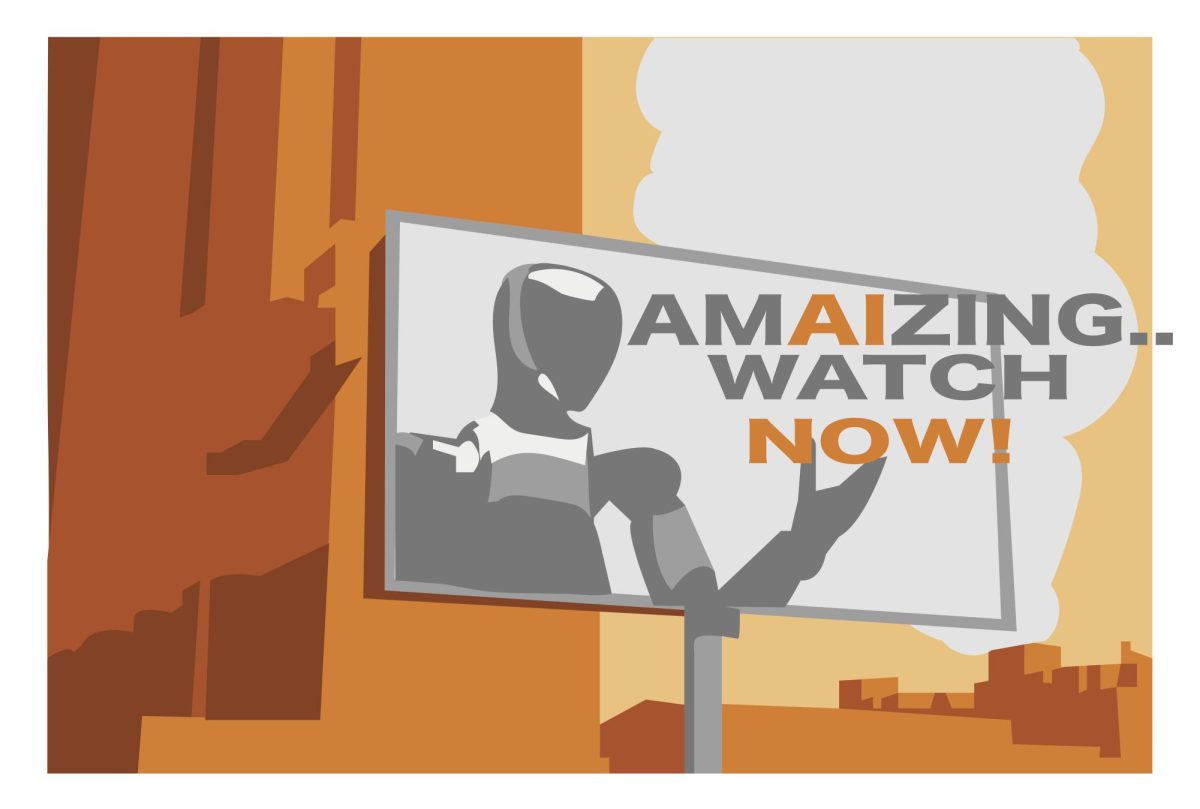
Despite these incidents, dozens of users have taken to platforms like TikTok to share their success “using AI as their therapist,” through popular AI chatbots like Ash, Headspace and Wysa. Clinical psychologist Harvey Lieberman even took to The New York Times to share his amazement of AI’s effectiveness, calling ChatGPT’s advice “brilliant.”
AI as an entry point for mental health support
Despite the headline-grabbing events, counselor Casey Danubio, she said she sees AI as a starting point for people seeking out mental health support.
“If they feel like they could express themselves with a computer, then I would say go ahead and do that,” Danubio said. “(It’s) better than doing nothing and just keeping it to yourself and internalizing negative feelings or you know, hurting yourself in some other way.”
Similarly, social worker Sara Knoop said AI can act as a guide to seeking further mental health treatment, rather than being the
treatment itself.
“When you are struggling, you can make the initial reach-out to AI or Google or whatever to look up symptoms or common coping skills or just different ways to deal with the situation that you’re in,” Knoop said. “I think when that becomes the only thing that you’re doing, that is the hard part, and that is the part where I don’t think it’s as well rounded of a treatment. I think with everything, balance is the key—using it as your only source of treatment is probably not ideal.”
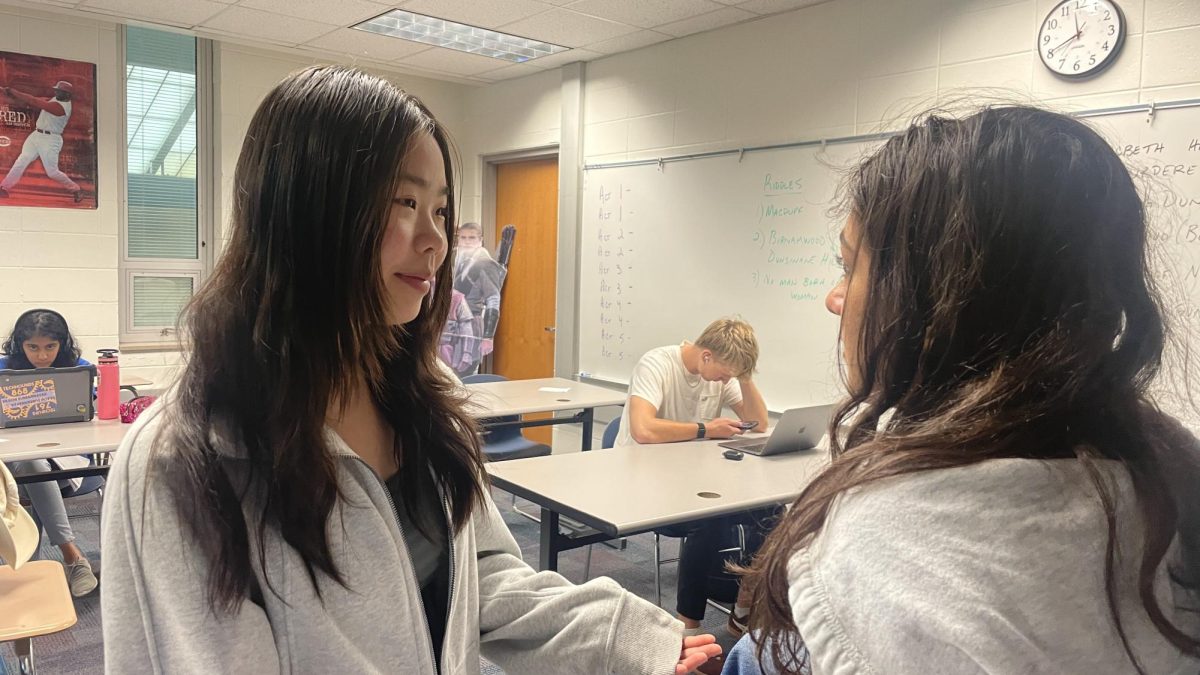
Along those lines, senior Ivy Wei said AI can make the distinction itself and advise users to look for other treatment options.
“Hopefully, all AI can remind people that they are not real, like how Siri does, and leave each person with information on how to access real human resources to improve mental health,” Wei said.
Convenience
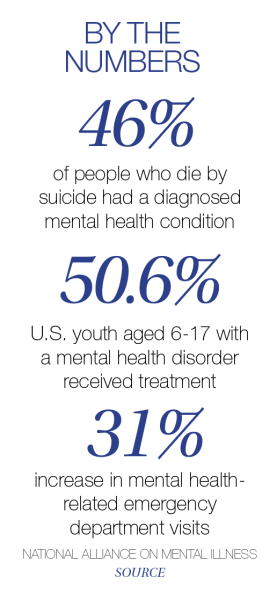
Recent studies show as much as 50 percent of individuals who could benefit from mental health services are unable to reach them.
In light of such challenges, Wei said AI is unprecedented in its ability to deliver support that is accessible to anyone.
“AI is revolutionary because it makes access to seemingly personalized therapy available for people that cannot access regular care,” Wei said.
Among these challenges, Danubio said time and cost are the greatest factors preventing people from seeking out therapy.
“People don’t want to wait,” Danubio said. “They don’t want to go for 15 sessions to a therapist and it costs $200 a session. They want quick results now. And within seconds, you know, you could say, ‘I’m feeling unwell about this,’ ‘I’m stressed about upcoming deadlines or whatever,’ and it comes back immediately.”
Danubio also said there is a line to be drawn in terms of what opinion people look for from AI.
“There is a very distinct difference between therapy and advice giving,” Danubio said. “If you’re just looking for a quick, ‘Hey, I’m, I need help organizing this problem in my head; can you give me some advice on this?’ That’s one thing. If you are actively, consistently seeking out a chatbot to like help you deal with long-term emotional distress or a diagnosis, that’s a little different.”
Alternatively, Knoop said other steps can be taken to reduce the cost of therapy, instead of turning to AI.
“It’s about finding what works for you, whether you’re on a medical insurance that can help cover the cost, if the cost is too exorbitant,” Knoop said. “Do you need to do something once a month or twice a month? Figure out how to balance it. Cost is always a concern, but there are a lot of ways to find cost inclusive options.”
Non-judgemental support
Although therapy has become less stigmatized in recent years, Danubio said many, especially young people, still feel uncomfortable
reaching out for help.
“I think definitely over the last decade there’s been a—the stigma has decreased in getting support, or asking for help, or talking to somebody, but I also think that the younger people feel so comfortable with the computer, with the chats, being online,” Danubio said. “For them it’s almost like a part of what they’ve always done. It’s who they are. It might be as comfortable and comforting to them as talking to a human for like an older person. It might be more comfortable because they don’t have to feel judged or they don’t have to tell anybody.”
On the other hand, Wei said chatbots may lack the same discernment real therapists have.
“I think it’s interesting that so many individuals with depressive symptoms turn to artificial intelligence LLMs, because they feel more comfortable being perceived by an algorithm that usually tells them what they want to hear rather than family, friends or a therapist who will try to get them help,” Wei said.
Misinformation
Knoop said she worries about the reliability of the information AI provides about mental illnesses.
“I think social media maybe is a good example of it. There are accounts that share things that mean really well, but maybe they are sharing misinformation or there are accounts that seem like they’re sharing good information, but it is coming from a false knowledge base. I think just like in any other topic, it’s about finding the right information and that’s why person-to-person can be a better conversation,” Knoop said. “If you are meeting with a therapist in-person or even over telehealth Zoom platforms, you’re at least then meeting somebody who has received professional training in that world and you know that because they will always share their licenses very willingly.”
Importance of human interaction
Wei said she is alarmed by recent events that depict the dangers of developing an attachment to AI.
“It also comes at a time where people’s relationship with AI is changing,” Wei said. “After all, more and more are considering these LLMs to be real, or at least real enough to start AI relationships with or talk about it as a person, like the Albanian government AI going through ‘pregnancy.’”
Knoop said the therapist-client relationship is important in providing effective treatment.
“AI is never going to replace the human interaction that you can get, and it’s just never going to replace the knowledge that a person can put into the situation that they’re dealing with right now,” Knoop said. “Yes, AI is like a fountain of knowledge. We all know this. Technically speaking, it can pull information from anywhere and provide an answer, but the nuances that human touch can provide AI is never going to be able to provide that the emotional support that humans can provide.”
In agreement, Danubio said talking with AI lacks the same emotional connection as sitting down and talking with another person.
“A large part of what makes therapy,—I mean, the research has said for forever—what makes therapy successful is the relationship that you have with your therapist,” Danubio said. “There’s a therapeutic effect to that which I don’t think you could mimic sitting behind a computer screen.”
Furthermore, she said human contact can allow for more nuanced conversation, providing multiple perspectives.
“Most people are going to have different opinions,” Danubio said. “Any human has to be able to take the information in that they’re getting from anybody or anything and decide, put aside what’s not going to work for them. You know, filter it, I guess is what I’m saying, and know, like, ‘OK, this might be helpful to me, this might not be,’ and if something feels weird, they should always talk to another human being to get a second opinion.”
Ultimately, Knoop said although she believes AI can provide short-term relief, an attempt should be made to foster long-term, human connections.
“I will never tell somebody not to take that first step in seeking help and if you need to do that through an AI platform or through Google—a search engine of any sort—that’s OK, do that” Knoop said. “But then figure out how to make the next step of asking for help in person, too, whether that’s to your parents, to an adult at school, to a friend, whoever that is, making that second step to get that in-person support.”