


















![Cal Carmichael starting for Carmel last season. Carmichael said he wants to do everything he can to help the team win every time he steps on the mound. [Submitted: Cal Carmichael]](https://hilite.org/wp-content/uploads/2026/04/Screenshot-2026-04-13-3.40.48-PM.png)

























![Review: Project Hail Mary is a visually stunning film filled with deep emotion, humor and a heartfelt partnership [MUSE]](https://hilite.org/wp-content/uploads/2026/05/PHM2-2.jpg)
![Review: “Iron Lung” exemplifies the success of suspense [MUSE]](https://hilite.org/wp-content/uploads/2026/04/IronLung-1200x675.webp)
![Review: New F1 regulations prove to be anything but boring [MUSE]](https://hilite.org/wp-content/uploads/2026/04/2-1-1200x675.avif)
![“‘Wuthering Heights’” wasn’t a bad movie—it just wasn’t anything like the book [MUSE]](https://hilite.org/wp-content/uploads/2026/02/wutheringh-960x1200.webp)
![Review: Season 5 of “Stranger Things" delivered the perfect ending despite major mistakes [MUSE]](https://hilite.org/wp-content/uploads/2026/01/ems-810x1200.jpg)
![Review: “Zootopia 2” is a stunning and engaging sequel that elevates the universe [MUSE]](https://hilite.org/wp-content/uploads/2025/12/bjUWGw0Ao0qVWxagN3VCwBJHVo6-800x1200.jpg)
![Review: I have no critiques: “Demon Slayer: Infinity Castle” is amazing [MUSE]](https://hilite.org/wp-content/uploads/2025/12/MV5BOGQ3YWUzYjEtMTJiYy00ZjQ0LWI0YjktYjhiNGVhNGExYTM3XkEyXkFqcGc@._V1_FMjpg_UX1000_-797x1200.jpg)
![Review: Learning to say “I” with “The Fountainhead” [MUSE]](https://hilite.org/wp-content/uploads/2025/12/The_Fountain_Head_1943_1st_ed_-_Ayn_Rand.jpg)
![Review: Java House Fall Menu [MUSE]](https://hilite.org/wp-content/uploads/2025/12/Screenshot-2025-12-01-at-15.10.19-1200x618.png)
![Review: "When I Fly Towards You", cute, uplifting youth drama [MUSE]](https://hilite.org/wp-content/uploads/2023/09/When-I-Fly-Towards-You-Chinese-drama.png)
![Postcards from Muse: Hawaii Travel Diary [MUSE]](https://hilite.org/wp-content/uploads/2023/09/My-project-1-1200x1200.jpg)










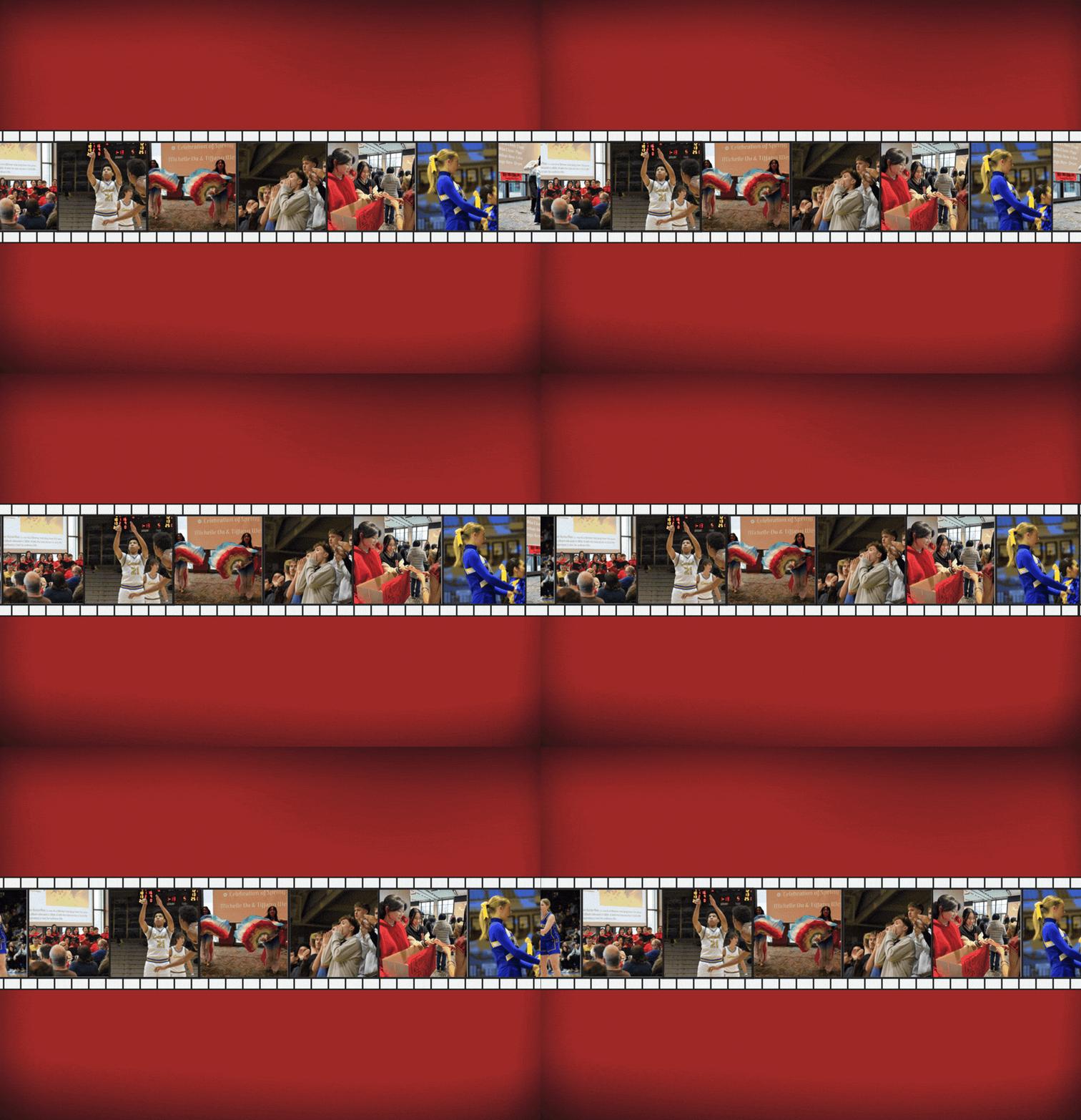
In a word that’s so divided over politics, religion and culture, you’d be hard pressed to find something that unites rather than causes rifts. Yet time and time again, sports manage to do just that. On courts, fields, and screens across the world, differences are put aside as people fade into a shared team and a shared identity.
You see it most clearly in the moments that don’t make the highlight reels. For example, strangers embracing after a last-second winning play, families with wildly different beliefs sitting shoulder to shoulder in the stands, fans groaning in unison at a bad call. These interactions are fleeting, but they matter. Sports create spaces where connection comes first and disagreement comes later.
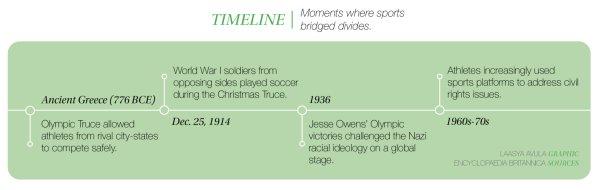
At their core, sports are built on shared rules and mutual respect for the game. No matter where you’re from or what you believe, the dimensions of the field don’t change, the rules of the game don’t change. The clock keeps running for everyone. A goal still counts. That common structure allows people to engage on equal footing, something increasingly rare outside of athletics. When everyone understands the stakes and the language of the game, seemingly divisive opinions become fodder, and mutual joy and camaraderie take precedent.
Sports also give people permission to care together. In everyday life, passion can feel risky. It can be too political, too personal or even too revealing. In sports, passion is expected. Screaming at a TV or crying over a loss isn’t embarrassing at all. That shared emotional vulnerability builds bonds that transcend background.

On a larger scale, sports have repeatedly served as bridges during moments of tension. International competitions like the Olympics bring together countries that may otherwise be at odds, reminding viewers that rivalry doesn’t have to mean hostility. Even when politics seep into sports, as they inevitably do, the games themselves often highlight our similarities more than our differences. Athletes train, sacrifice and dream in remarkably similar ways, regardless of the flag on their jersey. The greatest example of this perhaps is in December of 1914 during World War 1. Along the Western Front, British and German troops emerged from their trenches on Christmas Day. They exchanged cigarettes, sang carols, buried their dead and then, improbably, played soccer. On that Christmas day, soccer required no translation. On a battlefield built to emphasize difference, the game emphasized an intense sense of unity. Everyone understood when the ball crossed an imaginary goal line. Everyone knew what it meant to win, lose, or laugh it off.
Because of this, even a century later, the image endures. Men in uniform kicking around a ball in no man’s land. It revealed something enduring about human nature. Even in the most brutal circumstances, people search for connection and sports offer a way to find it.
Of course, sports aren’t perfect. They can amplify rivalries, reinforce stereotypes, and mirror the inequalities of the societies that produce them. But even then, they offer opportunities for growth. When athletes speak out, when leagues push for inclusion, when fans are forced to confront uncomfortable truths, sports become a platform for dialogue rather than division. Sports don’t erase conflict, it gives us a forum to engage with it collectively.
What makes sports uniquely unifying is their simplicity. At the end of the day, a game is about motion and momentum, about winning and losing, about trying again tomorrow. That simplicity cuts through the noise. It reminds us that joy can be shared without qualifiers, that belonging doesn’t always require agreement.