














![Cal Carmichael starting for Carmel last season. Carmichael said he wants to do everything he can to help the team win every time he steps on the mound. [Submitted: Cal Carmichael]](https://hilite.org/wp-content/uploads/2026/04/Screenshot-2026-04-13-3.40.48-PM.png)


















![Review: Project Hail Mary is a visually stunning film filled with deep emotion, humor and a heartfelt partnership [MUSE]](https://hilite.org/wp-content/uploads/2026/05/PHM2-2.jpg)
![Review: “Iron Lung” exemplifies the success of suspense [MUSE]](https://hilite.org/wp-content/uploads/2026/04/IronLung-1200x675.webp)
![Review: New F1 regulations prove to be anything but boring [MUSE]](https://hilite.org/wp-content/uploads/2026/04/2-1-1200x675.avif)
![“‘Wuthering Heights’” wasn’t a bad movie—it just wasn’t anything like the book [MUSE]](https://hilite.org/wp-content/uploads/2026/02/wutheringh-960x1200.webp)
![Review: Season 5 of “Stranger Things" delivered the perfect ending despite major mistakes [MUSE]](https://hilite.org/wp-content/uploads/2026/01/ems-810x1200.jpg)
![Review: “Zootopia 2” is a stunning and engaging sequel that elevates the universe [MUSE]](https://hilite.org/wp-content/uploads/2025/12/bjUWGw0Ao0qVWxagN3VCwBJHVo6-800x1200.jpg)
![Review: I have no critiques: “Demon Slayer: Infinity Castle” is amazing [MUSE]](https://hilite.org/wp-content/uploads/2025/12/MV5BOGQ3YWUzYjEtMTJiYy00ZjQ0LWI0YjktYjhiNGVhNGExYTM3XkEyXkFqcGc@._V1_FMjpg_UX1000_-797x1200.jpg)
![Review: Learning to say “I” with “The Fountainhead” [MUSE]](https://hilite.org/wp-content/uploads/2025/12/The_Fountain_Head_1943_1st_ed_-_Ayn_Rand.jpg)
![Review: Java House Fall Menu [MUSE]](https://hilite.org/wp-content/uploads/2025/12/Screenshot-2025-12-01-at-15.10.19-1200x618.png)
![Review: "When I Fly Towards You", cute, uplifting youth drama [MUSE]](https://hilite.org/wp-content/uploads/2023/09/When-I-Fly-Towards-You-Chinese-drama.png)
![Postcards from Muse: Hawaii Travel Diary [MUSE]](https://hilite.org/wp-content/uploads/2023/09/My-project-1-1200x1200.jpg)





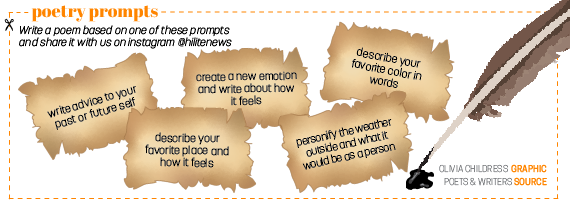
For any student of Jason ElRite, ninth grade English teacher, poetry is a regular part of his routine. Every week, he gives his students a prompt, on which they must base a poem. At the beginning of the last class of each week, ElRite takes about half an hour to stand at the front of the class and read these poems anonymously.
“I first started using poetry with my classes back in 1987. I did so because I didn’t have enough ideas to fill up class time,” ElRite said. “As a beginning teacher, I just didn’t know what else to do.”
Despite its humble beginnings, the activity caught on, and, according to ElRite, it has largely been a hit. Reactions to the poems range from a chant of “Deep, deep,” to laughs, to clapping or snapping. That part of class, ElRite said, often becomes one of his students’ most beloved parts of the course. ElRite recalled an occasion in which the mother of a former student recognized his name as the teacher who made her son write poetry seven years before.
 “It’s a tremendously valuable experience,” ElRite said. “Because we do it all anonymously, I’m the only person who knows that the quiet little person in the back is really getting a lot of positive feedback in a way they might never receive otherwise. So that can be very validating for them and it’s just interesting to see the reactions.”
This sentiment—that poetry can be accessible to everyone, regardless of skill—appears to be one that is shared by people all around the country and even the globe. Annually since 1996, the Academy of American Poets has recognized the month of April as National Poetry Month. According to the program’s website, the participation of various schools, libraries, publishers, booksellers and poets has made the event the largest literary celebration in the world.
Alli Johnson, now a junior, was a student of ElRite’s in her freshman year of high school.
“(Poetry was) super intimidating. It was just a sort of thing where it’s like, oh, well, there are professionals who do it and I’m not one of them. So I shouldn’t be doing it,” Johnson said.
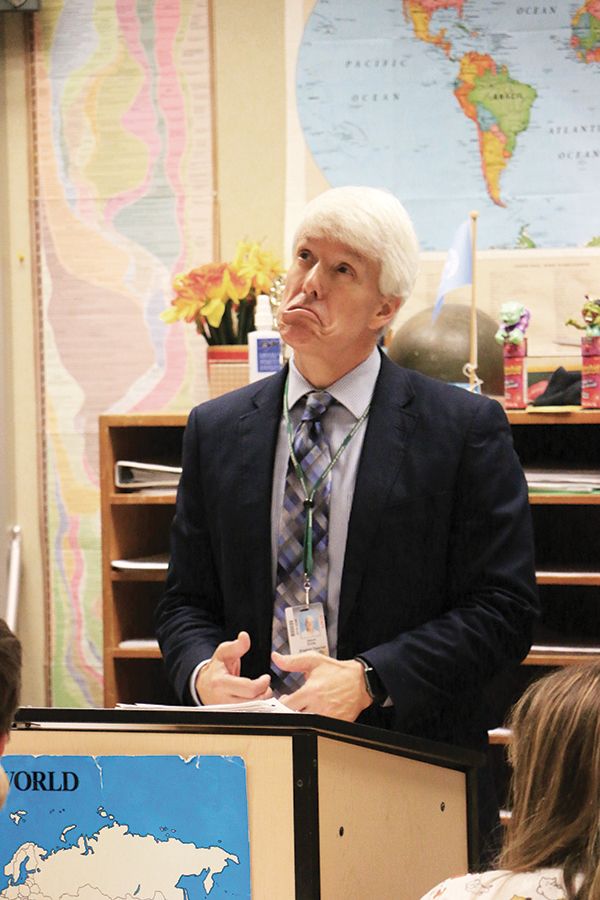
English teacher Jason ElRite reads “reverse poems” written by students in the Honors English 9/AP World History block class. ElRite said reading these poems out loud and anonymously can give validation to students who do not interact with their peers.
She said, however, that once she took ElRite’s class, her feelings changed.
“I feel like my perspective, although it was still the same sort of, ‘Boy, I really admire poetry,’ now it was sort of like, ‘Oh no, I’m actually doing it,’ she said. “So I used to be passive and now I’m actually active in it.”
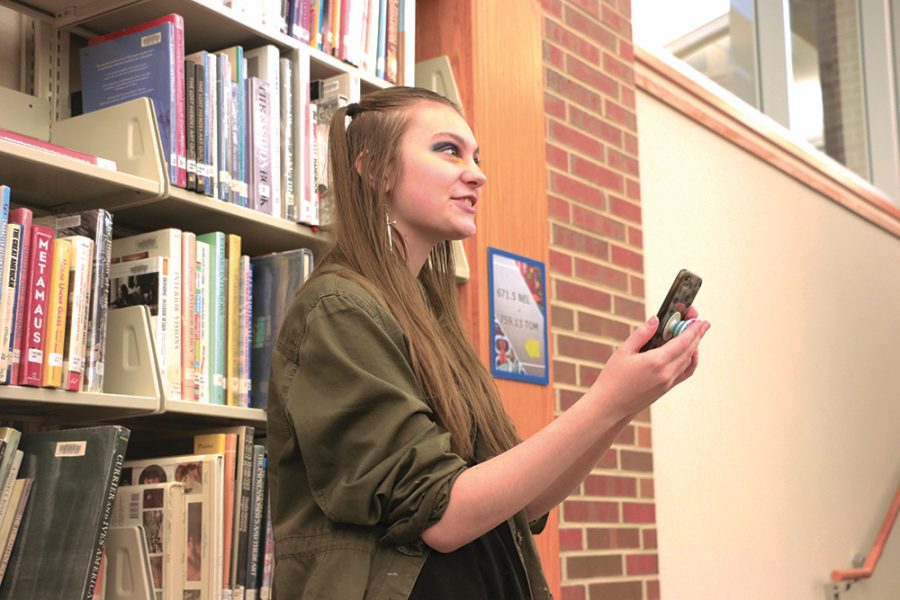
This year, a friend of Johnson’s, junior Runa Amin, started a poetry club at the school which meets every other Tuesday. Johnson, although not officially a leader of the club, attends meetings and was involved in the process of getting the club on its feet.
The club’s conception went through a couple of iterations before it became what it is today. Originally, Amin planned to start a movie club, but eventually settled on poetry.
“I, (despite being) the president, suck at poetry,” Amin said, laughing. “But I hope with this club I can get better at it because I feel like poetry is that one area of literature that everyone hates. (It’s) super underrated. So I thought making this club everyone would be better at it. You know, everyone would not be scared of it.”
2020 marks the 25th celebration of National Poetry Month and the 33rd year that ElRite has taught poetry. He said that although a lot has changed since 1987, students’ reactions to poetry have remained very much the same.
“Technologies can change, social norms can change, but we as fundamental human beings have not evolved in the last 100,000 years, much less the last 30 years. And so I think our desire to communicate our ideas as clearly as possible (hasn’t changed),” he said. “Words are such imperfect messengers… and so to try to relate how we truly feel to people just through words is so difficult. I think poetry, because of its form, because of its structure, allows us to do that the most accurately.”
And to ElRite, that is important.
“It helps to bring us all together in our common humanity. That I can write a poem, and whatever I write about is there’s going to be a large number of people who have felt the same way. Just because my skill set is in poetry, I’m able to express that,” ElRite said.
Amin said she agreed.
 “It’s really hard for people to say something they want to say. And I feel like through poetry that’s an easy way,” she said. “At one point I hated poetry when I was in middle school. It’s very underrated. (Some) people, they hate poetry. I know they hate analyzing it. And a lot of times, for like English projects and essays, we have to analyze a poem and compare it to another passage or whatever. And I just want to bring poetry to a better light, (so) when (people) come across a poem, they’re not just like, ‘Oh, no, I can’t understand this.’ I hope that if we learn different poetic elements that are used, and then people could enjoy it (and) enjoy its existence. No, it’s not a scary monster, it’s a form of literature.”
Part of the goal of National Poetry Month, as stated by the Academy of American Poets, is to “encourage the reading of poems” and “increase the attention paid to poetry by national and local media.” But it’s not just the Academy’s goal.
Johnson said, “I just want to let everyone know that poetry is for everybody. And I want everyone to stop being afraid of poetry, because it doesn’t have to be about the lover that you lost last year. It can be about your favorite food. And it can be about your family, or it could be about a TV show you like. Poetry is literally yours. And it can be whatever you want it to be as long as it’s good.”
Rip_Killaura • Feb 17, 2026 at 11:45 am
“dEeP DEeP” is not tuff gang like are we fr rn? Is bro genuinely tripping?? like, like, bro like, bro is not tuff ✌️ literally NO ONE is saying “one of the student’s most beloved parts of the course”